On this page
The short version
- You don't "rank" in ChatGPT. You get named in some share of answers, and that share moves every day.
- A brand AI happily names when you ask about it by name can vanish when a buyer asks who to buy from. In one test: 88% named on brand questions, 0% on ready-to-buy ones.
- Plenty of buying questions have no winner. 38 of 43 answers to one cost question named nobody at all.
- ChatGPT was the hardest of the four systems to get named in. Google AI Mode was the easiest.
- The fixes that worked were boring and specific: a page for the unclaimed question, your name on pages AI already reads, and listings on the sites AI trusts.
Every client call I've had this year has the same question buried in it. "Can you get us into ChatGPT?" Usually asked like ChatGPT is a directory with a sign-up form somewhere.
It isn't. So instead of guessing, I built a tool that asks the four big AI systems the questions real customers type, every single morning, and writes down every answer. That tool is LLM Visibility Lens. This article is what the first thousand-plus answers taught me about how to rank in ChatGPT, and about the three other places your customers now ask for recommendations.
No screenshots of one lucky answer. No "AI search volume" (nobody can measure that honestly, and anyone showing you a number for it is modelling). Just counts, with the sample size next to each one.
How we got the answers
The short answer: the same questions, put to four AI systems, anonymously, once a day each, and every reply stored word for word.
The four systems are ChatGPT, Google Gemini, Google AI Mode and Google AI Overviews. Each question goes to each system with no login, no history and no personalisation, set to the country (or, for Google, the city) the business serves. That's deliberate. A stranger searching for an electrician has no chat history with you either. What we store, and how, is on the security page.
For every answer we record two things. Was the business named in the text of the answer? And was one of its pages cited as a source? Those are different events, and mixing them up is where most "AI visibility" reports go wrong. The full method, including the maths behind the error ranges, is on the how it works page.
What's in the data. A test set of 60 answers about Pride Mobility, a US mobility-equipment brand. Several weeks of daily answers for Kato Electrical, an electrician in the Vancouver area, whose account is our public live demo so you can check every number below. And a smaller US online store we track, kept anonymous here. Where a number is a range (22–28), it's because the count shifted as new days came in.
What's not in it. Perplexity was added to the tool later and isn't in these figures. Claude and Copilot aren't tracked. And this is a handful of businesses, not a census of the web. Treat the patterns as strong signals, not laws.
"Ranking" in ChatGPT isn't a position
There is no position one in ChatGPT. There's a question, an answer, and your business is either in the answer or it isn't. Ask again and the answer may be different.
So the useful measure is a rate: out of every answer to the questions your customers ask, how many named you? That's what I mean by "ranking" in the rest of this piece. When someone says they "rank #1 in ChatGPT", ask how many answers they checked. If the answer is one, they got lucky once.
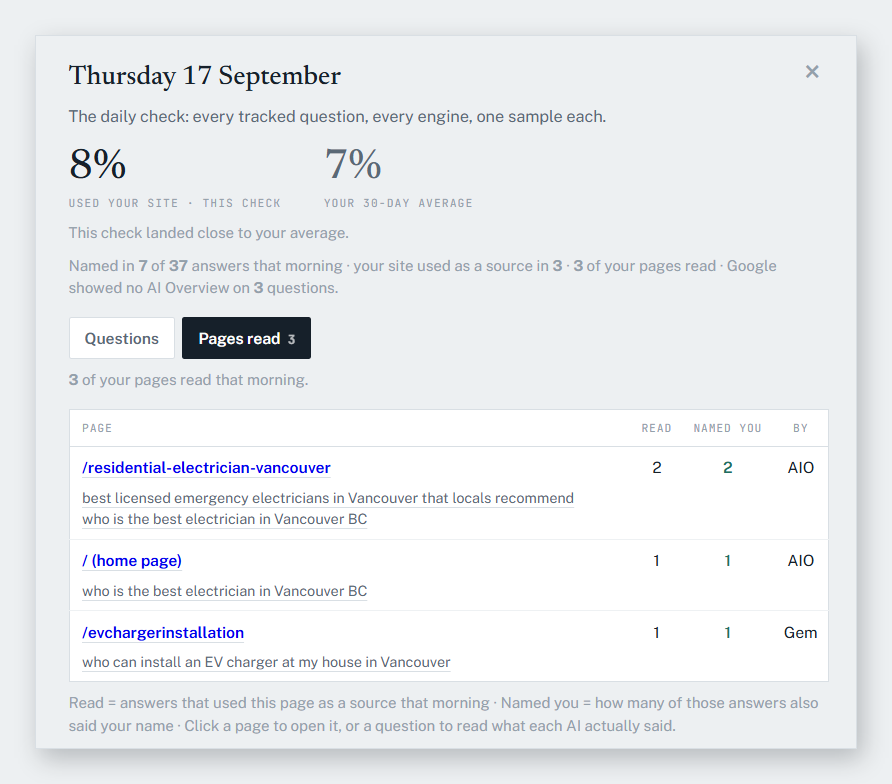
The named/cited split matters more than people expect. One of the first surprises in Kato's data: for emergency-electrician questions, AI read Kato's own page (/residential-electrician-vancouver) to build its answer, and then recommended other companies. Kato was the research. Someone else got the job. A report that counts citations as wins would have called that a good day.
Finding 1: visibility dies near the money
AI names a brand readily when you ask about the brand. It stops naming it the moment a buyer asks who to buy from.
Our first proper test was 60 answers about Pride Mobility, a well-known maker of mobility scooters and power chairs. We sorted every question by buying stage. On questions with the brand name in them, AI named Pride in 88% of answers. On transactional questions, the "where do I buy a power wheelchair" kind, it named them in 0%.
This one changed how I set up every client since. If you only test questions with your name in them, you'll conclude AI loves you. Most of the "we're visible in ChatGPT!" screenshots I get sent are exactly this: the owner typed their own brand name.
The questions that pay the bills don't have your name in them. So the tool's question finder reads your website and writes the questions customers actually ask, tagged by buying stage. You can try the question finder free on your own site. It takes about a minute.
Finding 2: many buying questions have no winner
For a surprising number of buying questions, AI names nobody. The spot is empty.
Kato's clearest example is the cost of a panel upgrade. We collected 43 answers to it across the four systems. Kato was named in none. The interesting number is the other one: 38 of those 43 answers named no business at all. They gave a price range, some general advice, and a line about contacting a licensed electrician.
That's an open door, not a lost cause. Nobody owns the question yet. A clear, specific page that answers it (real price ranges for the area, what drives the cost, what the permit involves, a named person who does the work) is the cheapest visibility you'll ever get. I went deeper on this in We asked AI who to hire 80 times.
| Buyer's question | Answers | Kato named | What was really going on |
|---|---|---|---|
| Best electrician in Burnaby | ~33 | 22–28 | Strong in AI answers, but Google shows no AI Overview for it at all |
| Three Coquitlam electrician questions | 80+ | 0 | One rival, Intel Power, named in about half; its site read about 30 times |
| Cost of a panel upgrade | 43 | 0 | 38 answers named no business: unclaimed |
| EV charger installation | 43–47 | — | One rival, TDR Electric, named in 26–29 answers |
Finding 3: one rival's page can own a topic
When a question does have a winner, it's usually one business, and usually because of one page.
Kato is named in most answers about Burnaby. In neighbouring Coquitlam, across more than 80 answers to three questions, he's named in none. A competitor called Intel Power turns up in roughly half of them, and the tool logged AI reading intelpower.ca around 30 times for those questions. Same trade, same region. The difference was that Intel Power had pages about Coquitlam and Kato didn't.
EV charger installation told the same story with a different name. TDR Electric was named in 26 to 29 of 43 to 47 answers. That's not a brand-awareness lead. It's a content lead: they had the page AI wanted to quote.
This is the most useful thing in the whole data set. When AI keeps naming a rival, look at which of their pages it reads. You'll usually find a page that answers the question more directly than anything on your site. Not better written, often. Just more specific.
Finding 4: ChatGPT is the hardest room to get into
The four AI systems don't agree with each other, and ChatGPT was consistently the stingiest.
Over Kato's tracking, Google AI Mode named him in about 30% of answers, Gemini about 20%, and ChatGPT around 16% (it has ranged from 13% to 19%). Early on the gap was starker. In one session ChatGPT answered 24 times and didn't name Kato once, while AI Mode named him in a third of its answers. Same questions, same morning.
My working theory, and it is a theory: Google's systems lean on Google's own local data (Business Profiles, reviews, maps) for local questions, which a real local business already has. ChatGPT leans more on what it finds on the open web, where a small business often has thin coverage. That points at two different fixes, which is why the playbook below has both.
Practical upshot: if a report gives you one "AI visibility" number, ask which AI. A blended score can hide a zero.
Finding 5: sometimes Google shows no AI answer at all
For some questions, Google simply doesn't show an AI Overview. The fight there is somewhere else.
"Best electrician in Burnaby" is Kato's strongest question in the AI systems that answer it. But across every check, Google never showed an AI Overview for it. It showed a map pack. So for that question the job isn't AI content at all. It's the Google Business Profile: categories, reviews, photos, service areas.
Our tool records these as "Google showed no AI Overview" rather than as a zero, and leaves them out of the score. It sounds like a small thing. It isn't. A tool that counts "no AI answer" as "not named" will tell you you're failing at a game Google isn't playing on that query. Google's own page on AI features and your website is worth reading for how it treats these.
Finding 6: the answer changes by lunch
Ask the same AI the same question twice and you can get a different answer. Not occasionally. Routinely.
We ran the same Kato check four times in one day, hours apart, with nothing changed in between. It came back 13, then 25, then 18, then 20.
That swing is bigger than most of the changes people claim credit for. If someone shows you "before: 13, after: 25" from two single checks, the honest reading is that nothing may have happened. It's also why our dashboard draws dots, not a smooth line, and puts a ± range on every score. A smooth line would be a lie.
See where you actually stand, not where one lucky answer puts you. Find your questions free, or open the live demo and click through Kato's real answers.
Does any of this send traffic?
Some, not much, and that's fine. Being named is the goal. Clicks are a bonus.
The Pew Research Center looked at the browsing of 900 US adults and found people clicked a normal result on 8% of Google visits that showed an AI summary, against 15% without one. They clicked a link inside the summary itself on about 1% of visits.
Our own numbers agree. The US online store we track connected its Google Analytics: about 50 visits from AI assistants in 30 days, roughly 0.3% of its 15,000 sessions. ChatGPT sent the most. Small. But those visitors arrive having already been told you're a good option.
The bigger effect is the one you can't click-track. The buyer who asks ChatGPT for three electricians and then types one of the names straight into Google. That shows up as a branded search, not as AI traffic. So judge AI visibility by how often you're named, and treat the visits as a lower bound.
How to rank in ChatGPT: the 8-step playbook
Here's what the data points to, in the order I'd do it. Every step ties back to a finding above. None of it is a trick.
- Make sure ChatGPT can actually read you. OpenAI's search crawler is called OAI-SearchBot, separate from GPTBot, which is for training. OpenAI's crawler documentation says sites that block OAI-SearchBot won't show up in ChatGPT search answers. Check your robots.txt, then check your CDN or firewall too. I found my own firewall's bot protection blocking scripts I needed; a well-meaning "block bots" switch can do the same to AI crawlers without you ever noticing.
- List the questions that don't have your name in them. Brand questions flatter you (finding 1). Write down the ready-to-buy and comparing questions for each service and each place you serve. That's your real scorecard.
- Take the empty seats first. Find questions where AI names nobody (finding 2) and write the page that answers them outright. First sentence answers the question. Then numbers, the area, the process, who does the work. No throat-clearing intro.
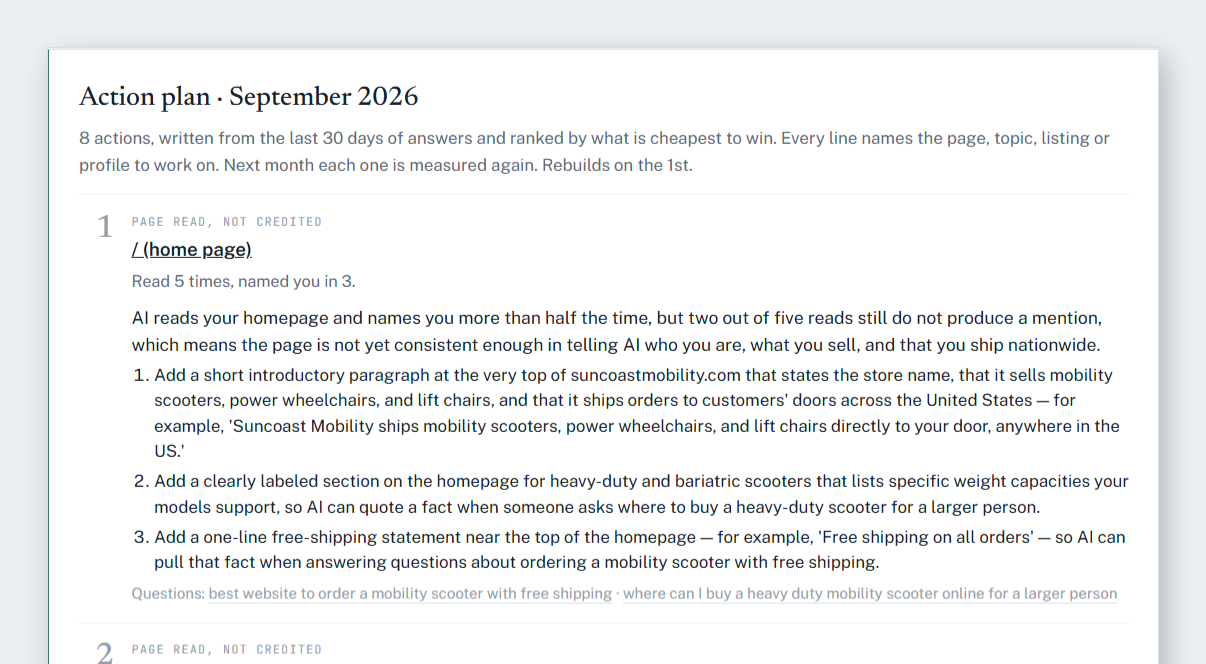
- Put your name on the pages AI already reads. If AI reads your page and recommends someone else, the page is missing a clear "we do this, here, call us" statement near the top. Say the business name, the service and the area in plain words. AI can't recommend what it can't attribute.
- Beat the rival's page, not the rival. Find the page AI keeps reading on the competitor's site (finding 3) and write a more specific one. In Coquitlam, the rival with a page about the town beat the business with an "areas we serve" list. A page per place you genuinely serve, with real jobs and real details, is the fix.
- Get listed where AI looks. The tool logs which outside sites AI reads for your questions: directories, review sites, local roundups. A genuine listing on the ones that keep coming up is often faster than new content. For ChatGPT, make sure you're in Bing Webmaster Tools as well as Google, since ChatGPT's search draws on outside search providers as well as its own crawler.
- Keep your business details identical everywhere. Same name, address, phone and services on every listing. Mark it up with LocalBusiness schema. For Google's systems, finish the Business Profile properly; on some local questions that profile is the whole game (finding 5).
- Measure a rate, over weeks. Re-check the same questions daily and compare rates over the same question set (finding 6). Change the questions and the comparison breaks. Give a change three to four weeks before you judge it.
You'll notice most of this is what good SEO already looked like. The research agrees. The GEO paper from Princeton, Georgia Tech and IIT Delhi found that adding statistics, quotations and cited sources made content more visible in generative answers. And Google's guide to helpful, people-first content reads like a checklist for this playbook. First-hand, specific, useful. That was always the job. AI just punishes the vague stuff faster.
What not to bother with
Screenshots of one answer. See the 13-to-25 swing above. One answer is an anecdote.
"AI search volume" numbers. OpenAI doesn't publish what people ask ChatGPT. Any tool showing you monthly volumes for prompts is estimating from Google keyword data and dressing it up. Useful as a rough hint, never as a fact.
Stuffing "ChatGPT" keywords into pages. The systems read for answers. A page that repeats a phrase twelve times reads like it has nothing to say.
Chasing citations alone. A citation without a name, as Kato's emergency page showed, is AI using your homework to recommend someone else.
Expecting it to be fixed in a week. Pages have to be found, read and trusted, and the answers wander in the meantime. Patience is part of the method, annoyingly.
How to track your own answers
You can do this by hand. Pick ten buying questions, ask each of the four systems daily in a logged-out window, note whether you were named, and keep it up for a month. Forty answers a day. It works. It's also very boring, which is why I built the tool.
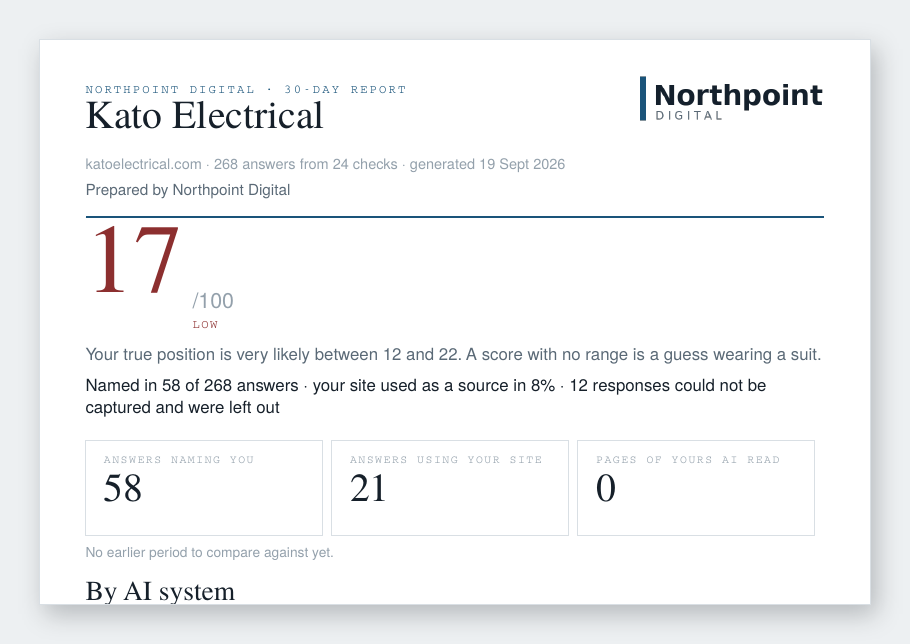
Or let LLM Visibility Lens do it. It writes the questions from your site, asks ChatGPT, Gemini, Google AI Mode and AI Overviews every morning, keeps every answer, and shows your named rate with its error range. You can click any day and read exactly what each AI said. The plans start free, and there's a straight comparison with Semrush's AI visibility tool if you're weighing the two. Agencies can send reports under their own name: see the agency page.
Everything we've shipped is listed, with dates, in the changelog. The common questions are on the FAQ page. And if you'd like me to look at your results with you, get in touch. Messages come straight to me.
Questions people ask
How do I rank in ChatGPT?
You don't get a fixed position in ChatGPT. You get named in some share of its answers. To raise that share, let OpenAI's search crawler (OAI-SearchBot) read your site, write pages that directly answer the buying questions nobody owns yet, state your business name, service and area clearly on pages AI already reads, get listed on the outside sites AI uses as sources, and measure your named rate over weeks rather than from one answer.
Can I pay to appear in ChatGPT's recommendations?
Not in the organic answers. Being named comes from what ChatGPT finds and trusts on the web. Anyone selling a guaranteed ChatGPT placement is selling something they can't control.
Why does ChatGPT recommend my competitor and not me?
In our data it was usually one specific page. The competitor had a page that answered the exact question (that town, that service, that price) and you didn't. Look at which of their pages AI reads and write a more specific, more useful one.
Is ranking in ChatGPT different from ranking in Google AI Overviews?
Yes. In our tracking the same business was named in around 16% of ChatGPT answers and about 30% of Google AI Mode answers for the same questions. Google's systems lean on Google's own local data such as Business Profiles; ChatGPT leans more on the open web. And for some questions Google shows no AI Overview at all, only a map pack.
How long does it take to show up in ChatGPT answers?
We don't have enough before-and-after cases yet to promise a timeline, and anyone who does is guessing. Because answers change even when nothing on your site does, judge a change over three to four weeks of daily checks on the same questions, not from a single before-and-after.
Does being mentioned in ChatGPT bring website traffic?
Some, but not much. Pew Research found people clicked links inside Google's AI summaries on about 1% of visits. A US store we track got about 0.3% of its sessions from AI assistants. Much of the value is invisible: buyers who hear your name from AI and then search for you directly.
What is the difference between being named and being cited?
Named means the answer's text recommends or mentions your business. Cited means one of your pages was listed as a source. You can be cited without being named, which means AI used your content to recommend someone else.
How can I check if my business shows up in ChatGPT?
Ask the questions your customers ask, not your brand name, in a logged-out window, and repeat daily for a few weeks. Or use an AI visibility tracker such as LLM Visibility Lens, which asks ChatGPT, Gemini, Google AI Mode and AI Overviews every morning and keeps every answer.

Harjeet Singh Bedi Founder, LLM Visibility Lens · SEO consultant, Bedi SEO
Harjeet is an SEO consultant who runs Bedi SEO and works hands-on with local businesses, online stores and agencies. He built LLM Visibility Lens after clients kept asking whether they showed up in ChatGPT and nobody could give them an honest, measured answer. Every figure in this article comes from answers his tool collected.