On this page
The short version
- ChatGPT doesn't keep a ranked list of businesses. It writes a fresh answer every time you ask, so "position #1" only ever describes one answer, once.
- In our data, the same check run four times in one day came back 13, 25, 18 and 20. Nothing had changed.
- Independent research from SparkToro found ChatGPT and Google's AI returned the same list of brands less than 1% of the time, and the same list in the same order less than 0.1% of the time.
- Your "rank" also depends on which AI, which town and which kind of question. A single number hides all three.
- The honest measure is a rate: how many answers named you, out of how many, with a range around it.
"We're #1 in ChatGPT."
I see that line in agency pitches, LinkedIn posts and tool dashboards. Sometimes with a screenshot. It sounds like a Google ranking, and that's the point: it borrows twenty years of trust in a number that meant something.
In ChatGPT it doesn't mean much. I say that as someone who sells an AI visibility tracker, so I'd better show my working. Below is what our own daily data says, backed by independent research, about why "AI rank" reports mislead, and what you should measure instead.
What an AI rank tracker actually does
Most ChatGPT rank trackers do something simple. They send your chosen question to ChatGPT, read the answer, find your brand in the list, and write down the position. Third mention, you're #3. Not mentioned, you're unranked.
That's a fair description of one answer. The trouble starts when that one answer is presented as your ranking, the way a Google position used to be, and then compared week to week as if it were stable.
Google's results for a keyword were fairly steady from one hour to the next. You could check once a week and learn something. An AI answer is not a page of results. It's a piece of writing, produced on the spot, and it can come out differently every time.
Why there's no position one to hold
Three reasons, from the plumbing up.
The model samples. A language model doesn't look up an answer. It picks each next word from a set of likely options, with some randomness built in. The team at Thinking Machines Lab wrote a detailed piece on why LLMs give different answers to the same prompt, and found that even with the randomness turned down to zero, the big hosted systems still don't return identical output in practice. You and your competitor are, in effect, rolling dice with loaded odds.
The sources change. When ChatGPT or Google's AI searches the web before answering, it may read different pages on different runs. Change the sources and you change who gets named.
The asker changes. A logged-in ChatGPT user brings their chat history and saved memories. Google's AI answers depend on location. A tracker asking from a clean, anonymous session sees none of that, which is fine, but it means nobody real sees exactly what the tracker saw either.
So when a tool says "#1", the honest question is: #1 in which of the many possible answers?
Proof 1: same question, same day, four different results
We didn't want to argue this from theory, so we tested it on a real account.
The account belongs to Kato Electrical, an electrician in the Vancouver area, and it runs as our public live demo, so you can check these numbers yourself. We ran the same check four times in one day, hours apart. Same questions. Same systems. Nothing changed on the website in between.
It came back 13, then 25, then 18, then 20.
A 12-point swing from nothing. Now picture an agency report that says "before: 13, after: 25, great month". Both numbers are real. The improvement might not be. I wrote about this and three other patterns in We asked AI who to hire 80 times.
Proof 2: the list reshuffles almost every time
Our numbers are one business. Someone did this at scale.
In early 2026, Rand Fishkin of SparkToro and Patrick O'Donnell of Gumshoe.ai published a study of AI recommendation consistency. Hundreds of volunteers ran the same prompts through ChatGPT, Claude and Google's AI nearly 3,000 times.
The headline, as Search Engine Journal reported it: ChatGPT and Google's AI returned the same list of brands under 1% of the time, and the same list in the same order under 0.1% of the time. The same report points to earlier Ahrefs research finding that Google's AI Mode and AI Overviews cite different sources 87% of the time for the same query.
That last figure matters. Even two AI features from the same company, answering the same question, don't agree on where to look.
Here's the part that gets lost, though. SparkToro also found that how often a brand appeared across many runs was far steadier than its position in any one list. The order is noise. The frequency is signal. That's the whole argument of this article in one finding.
Proof 3: "which AI?" changes the answer completely
A "rank in AI" figure usually blends several systems, or quietly picks one.
For Kato, across the same questions, Google AI Mode named him in about 30% of answers, Gemini about 20% and ChatGPT around 16% (it has ranged from 13% to 19%). Early on, ChatGPT answered 24 times without naming him once, while AI Mode named him in a third of its answers. Same morning.
So is Kato "ranking" in AI? In one system, often. In another, rarely. One blended number would tell you neither.
Proof 4: "which town?" changes it again
Local businesses have it worse, because location changes the answer too.
In Burnaby, Kato was named in 22 to 28 of roughly 33 answers. In neighbouring Coquitlam, across more than 80 answers to three questions, he was named in none. A rival, Intel Power, turned up in about half of those.
A tracker that checks "best electrician Vancouver" from one location would report one tidy position and miss both of those stories.
Proof 5: "how was it asked?" matters most of all
This is the one that fools business owners most often.
In a test of 60 answers about Pride Mobility, a well-known mobility brand, AI named the brand in 88% of answers when the question contained the brand's name. On ready-to-buy questions, the "where do I buy a power wheelchair" kind, it named them in 0%.
If your tracker's question list is full of your own brand name, your "rank" will look wonderful. Real buyers don't ask that way. The questions that matter are the ones without your name in them. That's why our question finder reads your site and writes buying questions, tagged by stage, instead of asking you to type prompts.
Three kinds of zero a rank tracker can't tell apart
A position-based tracker has one way to report failure: "not ranked". In our data, that one label covered three completely different situations, each with a different fix.
Nobody was named. For the cost of a panel upgrade, Kato wasn't named in any of 43 answers. But 38 of those answers named no business at all. That's not losing. That's an empty seat, and a specific page could take it.
Your page was read, but you weren't named. For emergency questions, AI read Kato's own page (/residential-electrician-vancouver) and then recommended other firms. The content was useful. It just never said plainly who does the work, where. Rank trackers that don't record sources can't see this at all.
There was no AI answer. For "best electrician in Burnaby", Google never showed an AI Overview on any check. It showed a map pack. Counting that as "not ranking in AI" sends you off to fix a problem that doesn't exist. Google's own page on AI features and your website explains that these only appear when its systems think they add something.
Three situations. Three fixes. One misleading label.
What to measure instead of AI rank
If position is noise (proof 1 and proof 2), what's signal? Four things.
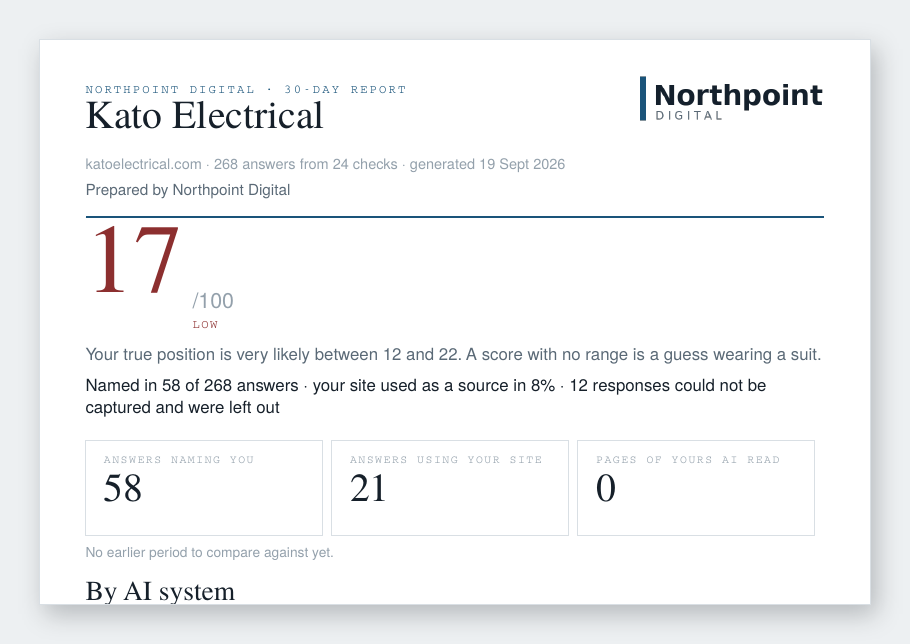
- Named rate, with a range. Out of every answer to your questions, how many named you? Report it with a margin of error and the sample size. "Named in 31% (±8), 120 answers" is honest. "#2" is not.
- Per engine. ChatGPT, Gemini, Google AI Mode and AI Overviews, separately. Blends hide zeros.
- Per kind of question. Brand questions, comparing questions and ready-to-buy questions reported apart, so a strong brand number can't cover a weak buying one.
- Sources, not just answers. Which of your pages AI read, which competitor pages it trusted, and whether you were cited, named, or both.
In our tool the headline score is a blend of the named rate and the cited rate (named counts 70%, cited 30%), always shown with its range, and every day is a dot you can click to read the actual answers. The maths is on the how it works page. You don't need our tool to adopt the principle, though. A spreadsheet of daily answers, counted honestly, beats any rank screenshot.
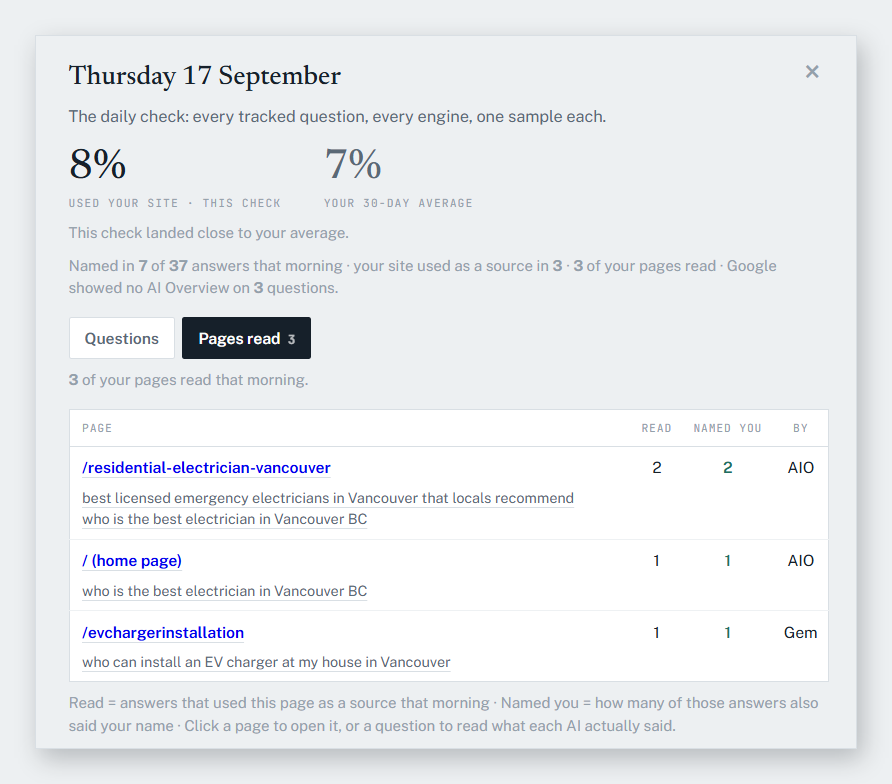
See your real rate, not a snapshot. Find your buying questions free, or open the live demo and click through a real business's daily answers.
How to spot a misleading AI rank tracker
Before you pay for any AI visibility tool, ours included, ask it these seven questions. Each one maps to a measure that actually works.
- How many answers is this number based on? If it won't say, or the answer is one, walk away.
- Is there a range or margin of error? A number without one is pretending to be precise.
- Which AI system is this? If it's a blend, can you see each one separately? (Proof 3 shows why.)
- Where was the question asked from? Country, city, logged in or not.
- Are my questions brand questions? Check whether the prompt list is padded with your own name (proof 5).
- Does it separate "no AI answer" from "not named"? If not, some of your zeros aren't real (see three kinds of zero).
- Can I read the actual answers and sources? If you can only see a position, you can't check the tool's work.
Trackers that report positions aren't lying about what they saw. They're reporting one frame of a film and calling it the plot. The SparkToro research makes the same point more bluntly. Whatever you pick, choose the one that shows you rates, ranges and raw answers.
What we built instead
I built LLM Visibility Lens because I couldn't find a tool that did all seven. It asks ChatGPT, Gemini, Google AI Mode and AI Overviews your buying questions every morning, keeps every answer and source, and reports how often you're named with a range around it. It never shows a rank.
Each month it also writes an action plan from that data: the unclaimed questions to take, the pages AI reads without naming you, and the competitor pages it trusts.
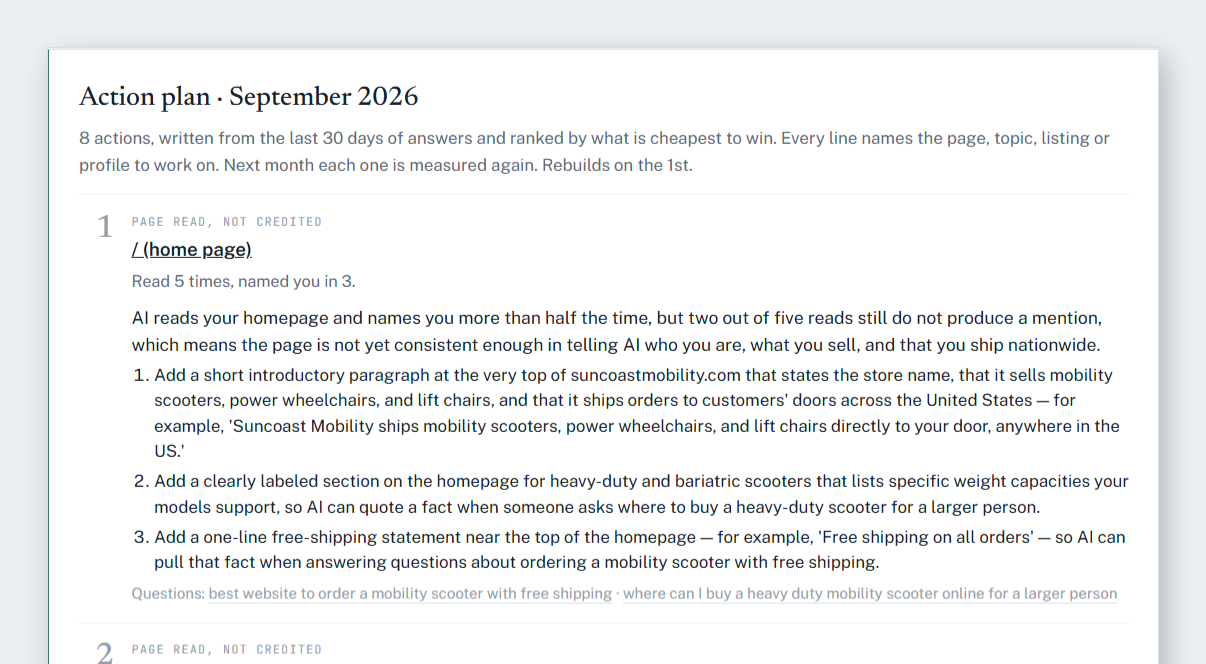
Agencies can send the monthly report under their own name and logo. It shows the score, its range and the answer counts behind it, never a made-up position. See the agency plan.
There's a plain comparison with Semrush's AI visibility tool if you're weighing the two, the plans start free, and everything we ship is listed in the changelog. You can also find us on G2. Questions about data and privacy are answered on the security page and the FAQ. And if you want a straight opinion on a report someone's sent you, send it to me.
If you want the practical next step after this article, read How to rank in ChatGPT: what 1,000 real answers say. It turns these findings into an eight-step playbook.
Questions people ask
Can you rank #1 in ChatGPT?
Not in any lasting sense. ChatGPT writes a new answer each time it's asked, so a business can appear first in one answer, fourth in the next and not at all in a third. What you can do is get named in a larger share of answers, and measure that share over time.
Are ChatGPT rank trackers accurate?
They accurately record one answer. The problem is treating that answer as a stable ranking. Independent research from SparkToro found ChatGPT and Google's AI returned the same list of brands less than 1% of the time for the same prompt. A position taken from one run tells you very little about the next.
Why does ChatGPT give a different answer every time?
Language models choose each word from likely options with some randomness, may read different web pages on different runs, and can be influenced by a user's location, history and memory. Even hosted models set to minimum randomness don't return identical output in practice.
What should I track instead of AI rank?
Your named rate: the share of answers that named your business, reported with a range and the number of answers behind it. Track it separately for each AI system and each kind of question, and look at which pages AI read to build its answers.
How many answers do I need before the number means anything?
More than a handful. Our own identical checks swung between 13 and 25 in one day, so a single check is noise. Daily checks over several weeks, on the same set of questions, give a rate you can trust, and a good tool shows the range so you can see how sure it is.
Is Google AI Overviews ranking different from ChatGPT ranking?
Yes. In our data the same business was named far more often by Google AI Mode than by ChatGPT, and for some questions Google showed no AI Overview at all, only a map pack. Ahrefs also found Google's AI Mode and AI Overviews cite different sources most of the time for the same query.
Does this mean AI visibility can't be measured?
No. It means it has to be measured as a rate, not a position. How often a business is named across many answers is far more stable than where it appears in any one answer, which is exactly what SparkToro's study found too.

Harjeet Singh Bedi Founder, LLM Visibility Lens · SEO consultant, Bedi SEO
Harjeet is an SEO consultant who runs Bedi SEO and works hands-on with local businesses, online stores and agencies. He built LLM Visibility Lens after clients kept asking whether they showed up in ChatGPT and nobody could give them an honest, measured answer. Every figure in this article comes from answers his tool collected.