On this page
The short version
We logged every source ChatGPT linked to in 291 answers about one Vancouver electrician: 1,220 citations across 92 websites. Here's where they went.
- Other businesses' own websites: 37%. Mostly rival electricians. (Why that matters.)
- "Best of" lists and rating sites: 35%. Sites like bestprosintown.com, trustanalytica.org and threebestrated.ca. (More.)
- Utility, regulator and city sites: 21%. BC Hydro alone was cited 141 times. (More.)
- Directories: 4%. HomeStars and BBB, a few Yellow Pages. (More.)
- The business's own website: 1%. But every one of those answers named it. (More.)
- Google Maps, Google Business Profile, Yelp: 0.
If you run a local business, that list is a to-do list. Here it is in order. The rest of this article is the evidence, and what I'd do with it.
How we counted ChatGPT citations
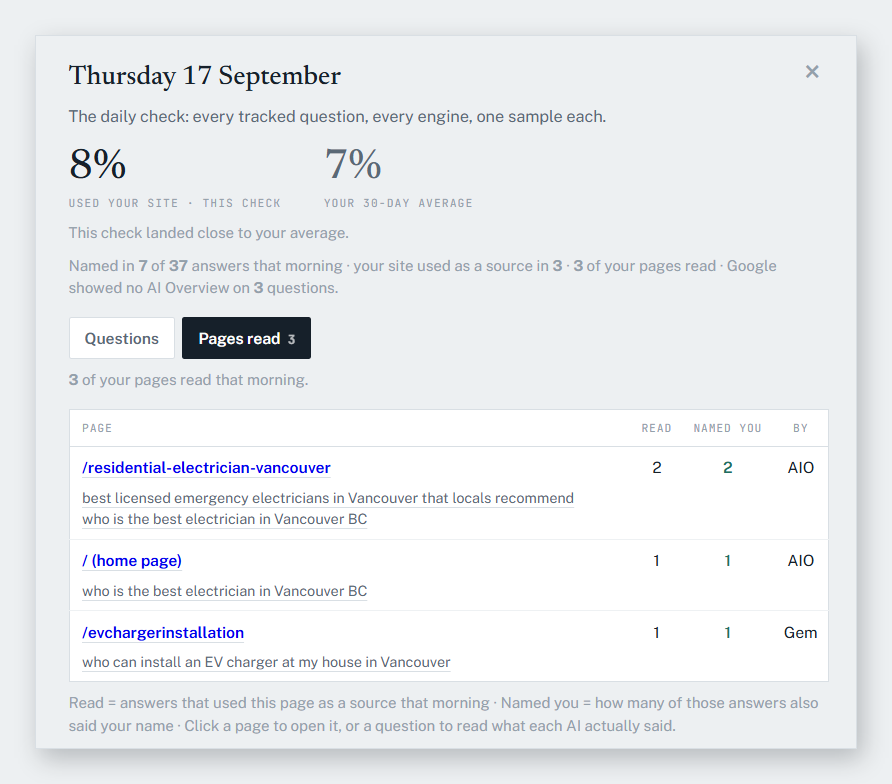
Every morning, our tool asks ChatGPT the questions a real customer would ask about a business, and stores the full answer with every source link. No login, no chat history, set to the business's country. The business here is Kato Electrical, a residential and commercial electrician in the Vancouver area. His account runs as our public live demo, so you can click into any of these answers yourself.
This article uses ChatGPT's answers from late August to late September 2026. 301 answers, 291 of which cited at least one source. Every link was cut down to its website (so www.homestars.com/companies/... becomes homestars.com) and counted. The full method is on the how it works page.
What this data can't tell you. It's one business, one trade, one city, in Canada. I sorted the 92 sites into types myself, and a few are judgment calls. And a citation count shows what ChatGPT read, not why it chose one business over another. Treat it as a close look at one market, not a law of the internet.
A word on bias: I sell an AI visibility tracker. The numbers below come straight from its database, and the demo is public so you can check them.
The sites ChatGPT actually cites
Here are the twelve websites ChatGPT cited most across those 291 answers.
Three things jump out.
No Google. Not Maps, not a Business Profile, not a single google.com link, in 1,220 citations. Plenty of local SEO advice treats the Google Business Profile as the key to AI visibility. For Google's own AI, that's fair (more on that below). For ChatGPT, in this data, it never came up.
No Yelp. Also zero. That surprised me, because BrightLocal's large study found Yelp was the single most-used source for ChatGPT. Their data covers the US, UK and Australia. Ours is a Canadian electrician, where HomeStars seems to fill that role. Location and trade change the answer.
Lists beat directories. The "best electricians in Vancouver" style of site was cited eight times as often as the classic directories.
Grouped by type, it looks like this:
| Type of site | Citations | Websites | Examples |
|---|---|---|---|
| Other businesses' own sites | 457 | 52 | intelpower.ca, groveelectric.ca, eurotechelectric.ca |
| "Best of" lists and rating sites | 431 | 19 | bestprosintown.com, trustanalytica.org, verifiednode.com, threebestrated.ca |
| Utility, regulator and city sites | 256 | 14 | bchydro.com, technicalsafetybc.ca, vancouver.ca |
| Directories | 51 | 4 | homestars.com, bbb.org, yellowpages.ca |
| Reddit and local news | 13 | 2 | reddit.com, vancouver.citynews.ca |
| The business's own site | 12 | 1 | katoelectrical.com |
Want to know what ChatGPT reads for your business? The question finder writes the questions your customers ask, free, in about a minute.
Your own website: rarely cited, but it works when it is
Kato's website was cited in only 11 of 291 ChatGPT answers. That's under 4%.
But look at what happened in those 11: ChatGPT named Kato in all 11. When ChatGPT read his site, it recommended him. The problem wasn't the site's quality. It was that ChatGPT mostly didn't go there.
Compare Gemini, which cited katoelectrical.com 60 times in 22 answers. Same website, same questions, very different reach. The likely reason is plumbing: ChatGPT's search leans on its own crawler and on outside search indexes, while Gemini sits on Google's. So the first jobs are unglamorous:
- Check that OpenAI's search crawler, OAI-SearchBot, isn't blocked. OpenAI's crawler documentation is explicit that blocked sites won't appear in ChatGPT search answers. Check your firewall too, not just robots.txt.
- Get the site into Bing Webmaster Tools and submit the sitemap. Plenty of local businesses have never done it.
- Write the pages ChatGPT is looking for. In Kato's data, the questions with no winner (like panel-upgrade cost, where 38 of 43 answers named no business at all) are exactly where a clear, specific page could get read.
I covered that last point at length in How to rank in ChatGPT: what 1,000 real answers say.
Competitors' websites: the biggest slice
More than a third of all ChatGPT citations went to other businesses' own websites. 52 of them.
This is the uncomfortable one. When ChatGPT read a rival's site, it usually recommended the rival. intelpower.ca was cited in 44 answers and Kato was named in none of them. groveelectric.ca: 32 answers, none. coquitlamelectric.ca: 22, none.
You can't get listed on a competitor's website. What you can do is find out which of their pages ChatGPT keeps reading, and why. In Kato's case, Intel Power had pages about Coquitlam and Kato didn't, and Kato was named in 0 of 80+ answers about that suburb. I wrote up that example in We asked AI who to hire 80 times. The fix was a page, not a listing.
"Best of" lists: the sites nobody talks about
A third of ChatGPT's citations went to sites whose whole job is ranking local businesses: bestprosintown.com (93 citations), trustanalytica.org (73), verifiednode.com (53), threebestrated.ca (36), industryoversight.ca and bests.ca (35 each), and more.
Most local SEO checklists don't mention these. ChatGPT clearly reads them.
And whether you're on them seems to matter a lot:
When ChatGPT cited threebestrated.ca, Kato was named in 20 of 31 answers. When it cited bestprosintown.com, just 6 of 67. Same kind of site, very different result. The simplest explanation is that he appears on one list and not the other, although this data can't prove that on its own.
That chart comes with a warning I'll repeat: it shows association, not cause. An answer cites several sites at once, so a list and a directory often show up together. Still, the gap between 65% and 9% is too big to ignore.
A caution before you rush off. Some of these list sites are editorial, some invite nominations, and some sell placement. Look at how a site picks businesses before paying anyone for anything.
Directories: small in number, strong in effect
The classic directories were a small slice: HomeStars 32 citations, BBB 15, Yellow Pages 3, Facebook 1.
Small, but look at the named rates. When ChatGPT cited BBB, Kato was named in 11 of 15 answers (73%). With HomeStars, 19 of 28 (68%). His overall rate is 16%. Directory profiles seem to work less as a traffic source for ChatGPT and more as confirmation: a trusted third party saying this business exists, does this work, and gets good reviews.
For a Canadian trade, HomeStars and BBB are the two I'd fix first. In the US, BrightLocal's study suggests Yelp, BBB and Angi. The principle is the same: be complete and well-reviewed on whichever directories ChatGPT actually cites for your trade and country, and don't bother with fifty you'll never see in an answer.
Utility and regulator sites: you can't be listed, but you can be useful
BC Hydro was the most-cited single website, 141 times across its main site, app and outage pages. Technical Safety BC (the province's electrical regulator) was cited 48 times, and the City of Vancouver 40.
These aren't recommendation sources. ChatGPT reads them for the facts behind a question: rebates, permits, safety rules, outage information. Kato was named in only 3 of 58 answers citing bchydro.com and none of 21 citing technicalsafetybc.ca, because those answers were mostly about rules, not recommendations.
Two things you can do anyway. Write pages that explain those rules for your area, in plain words, with your name on them, and link to the official source. ChatGPT then has a page that answers the question and names a business who can do the work. And if a rebate or safety program you work with keeps a public list of contractors, get on it.
ChatGPT vs Google's AI: different sources
The same questions, asked of Google's AI, drew on a very different set of sites. Here's a comparison from the same account and period.
| Source | ChatGPT | Gemini | Google AI Mode |
|---|---|---|---|
| Google (Maps / search pages) | 0 | 299 citations (maps.google.com) | 2,497 citations (google.com) |
| The business's own site | 12 | 60 | not in its top 10 |
| HomeStars | 32 | 44 | 117 |
| Yelp | 0 | fewer than 3 | 61 (m.yelp.ca) |
| 12 | 4 | 87 | |
| Competitors' booking pages | 0 | 0 | 242 (Housecall Pro, Jobber) |
| Named the business | 16% of answers | 21% | 32% |
Google's AI leans on Google's own local data, which is why AI Mode named Kato twice as often as ChatGPT did. So the Google Business Profile still matters a lot, just not for ChatGPT. Google explains how its AI features choose content in AI features and your website.
One oddity worth knowing: AI Mode cited competitors' online booking pages (on Housecall Pro and Jobber) 242 times. If you take online bookings through one of those tools, make sure the public booking page carries your full business name, services and area.
Cited is not the same as named
One more thing a citation count hides. Being cited and being recommended are different events.
For emergency-electrician questions, AI read Kato's own page and then recommended other firms. His page was the research. Someone else got the job. The same gap shows at scale in the ChatGPT data: it cited bchydro.com in 58 answers and named Kato in only 3 of them.
That's why our tool records both, separately. A report that counts citations as wins would have called those good days. You can see both, answer by answer, in the live demo.
What the big study found, and where we differ
BrightLocal's study ran 60,970 checks for 1,355 business locations across Google AI Overviews, AI Mode and ChatGPT. Three findings are worth putting next to ours.
Yelp. They found it made up 8.53% of all citations and was the top source for ChatGPT. We found zero Yelp citations from ChatGPT, for a Canadian electrician. Country and trade matter.
Business websites. About 93% of the domains they saw cited were individual business websites. In our data, 53 of the 92 sites ChatGPT cited were businesses' own websites, about 58%. The lists and utility sites took a bigger share in one market than they do across thousands.
Breadth. They found 116,000 unique domains across all their locations. We found 92 for one business. The long tail is real, and it's different for every business.
The honest conclusion: the only way to know which sites ChatGPT cites for your business is to look at your own answers.
Where to get listed, in order
Here's the order I'd work in for a local business, based on this data.
- Make your own site readable by ChatGPT. Allow OAI-SearchBot, submit to Bing, and write pages that answer your customers' actual questions. When ChatGPT read Kato's site, it named him every time.
- Fix your two main directories. For a Canadian trade, HomeStars and BBB: complete profiles, real reviews, the same name, address and phone as your site. Mark your site up with LocalBusiness schema so the details match.
- Find the "best of" lists ChatGPT reads for you. Check whether you're on them. Read how each one selects businesses before paying for anything.
- Study the rivals ChatGPT cites. Find the pages it reads on their sites, and write more specific ones for the services and places you really cover.
- Explain the official rules for your area. Rebates, permits, safety. Link to the official source, and put your name on the explanation.
- Keep your Google Business Profile strong anyway. ChatGPT didn't cite it here, but Google's own AI leans on it heavily.
- Re-check monthly. Sources change. Answers change even when nothing on your site does; see why there's no rank #1 in ChatGPT.
How to see the sites ChatGPT cites for your business
You can do this by hand: ask ChatGPT your customers' questions in a logged-out window, click every source, and tally them in a spreadsheet. Do it for a few weeks and you'll have a rough version of the chart above.
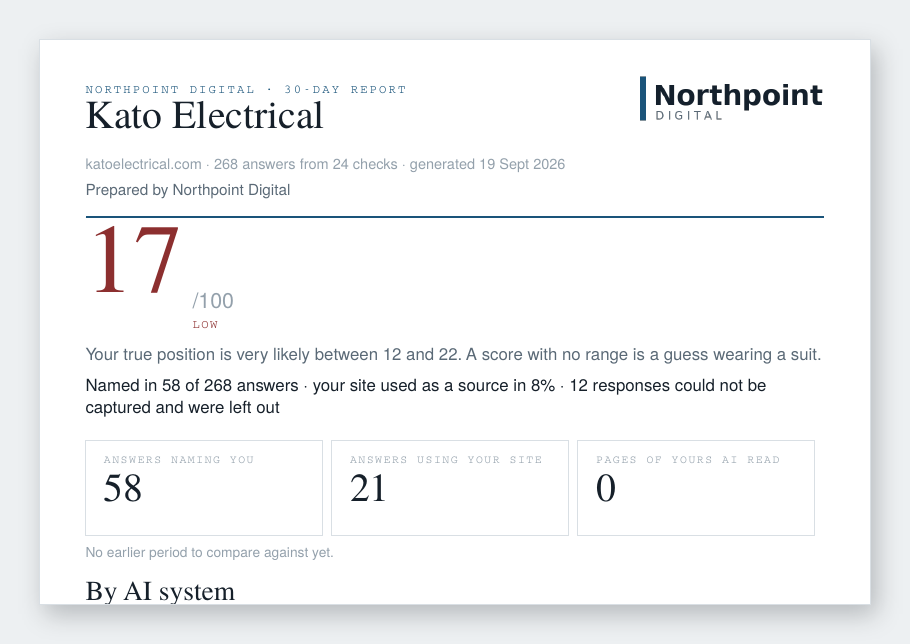
Or let LLM Visibility Lens do it. Every morning it asks ChatGPT, Gemini, Google AI Mode and AI Overviews your buying questions, stores every source, and sorts them into your own pages, sites you could get listed on, and competitors' sites you can't. Each month it turns that into an action plan.
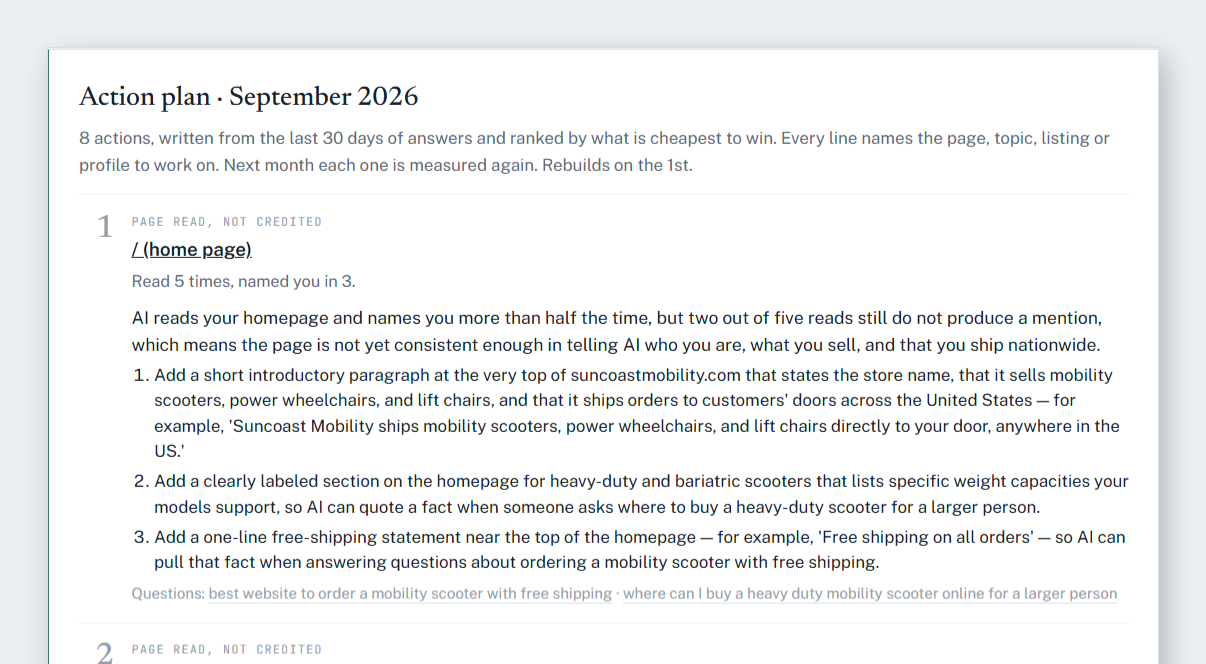
Agencies can send the monthly report under their own name, including the "Sites to get listed on" section. See the agency plan.
The plans start free. There's a plain comparison with Semrush's AI visibility tool, everything we ship is in the changelog, and common questions are on the FAQ page. How we handle your data is on the security page. You can also find us on G2. If you'd like me to look at your own sources, get in touch.
Questions people ask
Which websites does ChatGPT cite for local businesses?
In our data for a Vancouver electrician, ChatGPT's 1,220 citations went mostly to other businesses' websites (37%), "best of" list and rating sites (35%) and utility, regulator and city sites (21%). Directories like HomeStars and BBB made up 4%, and the business's own website 1%. It never cited Google Maps, a Google Business Profile or Yelp.
Does ChatGPT use Google Business Profile?
Not in our data. Across 1,220 ChatGPT citations for local electrician questions, none pointed to Google Maps or a Business Profile. Google's own AI is different: Gemini cited maps.google.com 299 times and Google AI Mode cited google.com pages 2,497 times for the same questions. Keep the profile strong for Google, but don't rely on it for ChatGPT.
Does ChatGPT cite Yelp for local businesses?
It depends on the market. BrightLocal's study across the US, UK and Australia found Yelp was ChatGPT's top local source. In our Canadian electrician data, ChatGPT cited Yelp zero times and used HomeStars and BBB instead. Check which directories appear in your own answers before investing in any of them.
How do I get my business cited by ChatGPT?
Make sure OpenAI's search crawler can read your site, submit it to Bing Webmaster Tools, and write pages that directly answer your customers' questions. Then get complete, well-reviewed profiles on the directories and "best of" lists ChatGPT actually cites for your trade and area. In our data, when ChatGPT cited the business's own site, it named the business every time.
Is being cited by ChatGPT the same as being recommended?
No. ChatGPT often cites a page for facts and then recommends someone else. In our data it cited BC Hydro in 58 answers and named the business in only 3, and when it read a rival's website it named that rival rather than our business. Track citations and recommendations separately.
Why does ChatGPT cite my competitor's website instead of mine?
Usually because their site has a page that answers the exact question, such as a service in a specific town, and yours doesn't. ChatGPT also reached our business's site far less often than Gemini did, which points to crawling and indexing as much as content. Check OAI-SearchBot access and Bing indexing, then write the missing page.
How can I see which sites ChatGPT cites for my business?
Ask ChatGPT your customers' questions in a logged-out window, open every source link and tally the websites over several weeks, since answers change daily. Or use an AI visibility tracker that stores every source automatically and sorts them into your pages, sites to get listed on and competitors' sites.

Harjeet Singh Bedi Founder, LLM Visibility Lens · SEO consultant, Bedi SEO
Harjeet is an SEO consultant who runs Bedi SEO and works hands-on with local businesses, online stores and agencies. He built LLM Visibility Lens after clients kept asking whether they showed up in ChatGPT and nobody could give them an honest, measured answer. Every figure in this article comes from answers his tool collected.