On this page
The short version
In the first week we tracked both, on the same 16 questions and the same days, Perplexity recommended our local test business more than twice as often as ChatGPT did.
- Named the business: Perplexity 25% of answers (20 of 80), ChatGPT 10% (10 of 96). The ranges barely touch. (The numbers)
- Used the business's own website: Perplexity in 56% of answers, ChatGPT in 2%. This is the real difference. (Why it matters)
- Sources per answer: Perplexity 21.8, ChatGPT 4.3.
- Where they look: Perplexity leans on classic directories (BBB, Yellow Pages, HomeStars). ChatGPT leans on "best of" list sites and utility pages. (What each cites)
- The catch: it's one business and one week. Perplexity also pulled in a surprising amount of irrelevant, overseas material. (What we don't know)
People ask me "Perplexity vs ChatGPT?" as if one of them has to win. For a local business, the more useful question is which one actually recommends you, and why. We started tracking Perplexity alongside ChatGPT and Google's AI last week, so here's the first honest look, with every number traceable.
How we compared them
The short answer: the same questions, on the same days, to both tools, with everything kept.
Our tool, LLM Visibility Lens, asks each AI system the questions a real customer would type, once a day, without logging in, and stores every answer and every source link. The business is Kato Electrical, a residential and commercial electrician in the Vancouver area. Its account is our public demo.
We added Perplexity on 23 September 2026, and its first full daily check ran on the 24th. So this comparison only uses 23 to 28 September, and only the 16 questions Kato tracks, for every system. That matters. Comparing a month of ChatGPT with a week of Perplexity would be meaningless, because AI answers swing from day to day.
What this data can't tell you. Five or six days, 80 Perplexity answers, one business, one trade, one city. That's enough to see a clear gap, not enough to call it permanent. We'll rerun this in a month. The method, including how the ranges are worked out, is on the how it works page.
I sell an AI visibility tracker, so treat this with that in mind. The demo is public, so you can check it.
Who named the business more often
Perplexity, clearly, in this first week.
| AI system | Answers | Named Kato | Named rate | 95% range |
|---|---|---|---|---|
| Perplexity | 80 | 20 | 25% | about 15–35% |
| Google AI Mode | 96 | 19 | 20% | about 12–28% |
| Gemini | 96 | 14 | 15% | about 8–22% |
| AI Overviews | 82 | 12 | 15% | about 7–22% |
| ChatGPT | 96 | 10 | 10% | about 4–16% |
The range column is there because a percentage from 80 answers isn't exact. Perplexity's lowest plausible value (about 15%) sits right at ChatGPT's highest (about 16%). So the gap is real enough to take seriously, but not so wide that one more week couldn't narrow it.
For context, ChatGPT named Kato in 16% of answers across the whole previous month. This week's 10% is on the low side for ChatGPT, which is normal. Rates move.
Want to see which questions your customers ask these tools? The question finder writes them from your website, free.
Perplexity reads your website. ChatGPT mostly doesn't.
This is the difference that explains the rest.
Perplexity cited katoelectrical.com in 45 of its 80 answers. ChatGPT cited it in 2 of 96.
And look at how naming follows. Every single one of the 20 Perplexity answers that named Kato also cited his website. When Perplexity read the site, it named him in 20 of 45 answers (44%). When it didn't read the site, it never named him.
ChatGPT showed the same logic over the previous month: when it did read Kato's site, it named him every time. It just hardly ever went there. We covered that in ChatGPT citations: the sites it cites for local businesses.
Part of the reason is volume. Perplexity pulled 21.8 source links per answer on average; ChatGPT, 4.3. Read five times as many pages and a business's own site is far more likely to be one of them.
So for Perplexity, your website is the main lever. Perplexity's own crawler documentation recommends allowing its crawler, PerplexityBot, in robots.txt and letting its published IP addresses through if you want to appear in its results. Check your firewall as well as robots.txt. I found my own site's bot protection blocking legitimate automated requests without any warning.
What each one cites
Both tools lean on other businesses' websites, but they pick very different third-party sources.
| Type of site | Perplexity (this week) | ChatGPT (previous month) |
|---|---|---|
| Other businesses' own websites | 53% | 37% |
| Directories and listing sites | 34% | 39% |
| of which classic directories (BBB, Yellow Pages, HomeStars, Yelp) | most of it | 4% |
| of which "best of" list sites | a small part | 35% |
| Utility, city and safety sites | 2% | 21% |
| The business's own website | 3% | 1% |
| News and unrelated sites | 7% | about 1% |
The ChatGPT column comes from our month-long citation count, so the periods differ. Treat the comparison as a picture of habits, not a precise match.
Perplexity goes to the classic directories. BBB was its most-cited single site (106 links), then Justdial (102), then Yellow Pages (99) and HomeStars (94 across two addresses). It also used Home Depot's store pages, Bark and Houzz. ChatGPT barely touched any of these. It preferred "best electricians in Vancouver" list sites such as bestprosintown.com.
Directories helped. When Perplexity cited BBB, Kato was named in 14 of 28 answers (50%). With Yellow Pages, 15 of 48. With HomeStars, 17 of 51. His overall Perplexity rate was 25%. As always, that's association, not proof: answers cite many sites at once.
ChatGPT goes to the rulebook. 21% of ChatGPT's sources were utility, regulator and city pages (BC Hydro above all). Perplexity: 2%.
Rivals matter to both. Perplexity's most-cited competitor sites were intensevoltage.com (57 links), intelpower.ca (52) and groveelectric.ca (27). Intel Power and Grove Electric also top ChatGPT's list of rival sites. When a rival shows up across tools like that, study its pages.
For a wider view of which directories AI tools use in local search, BrightLocal's study of more than 60,000 checks is worth reading next to this.
How they differ in the way they answer
Beyond the headline numbers, the source data shows two quite different habits.
Perplexity casts a wide net. Twenty-odd sources per answer likely means more businesses get a look in, including small ones with a decent website. That's good for a business like Kato, and part of why he did better there.
The net catches junk. 125 of Perplexity's links (7%) went to news and unrelated sites: weather pages, US local news, and stories from India, Russia, Korea and elsewhere. The second most-cited site of all was Justdial, an Indian business directory, for questions about Vancouver electricians. Those sources didn't lead to recommendations (Kato was named in none of the 10 answers citing Justdial), but they show that more sources isn't the same as better ones.
ChatGPT is choosier and harder to crack. Fewer sources, more third-party lists and official pages, and your own site rarely makes the cut. In this week's data it's the hardest of the five systems to get named in, and it was near the bottom over the whole month too.
Google's two AI features sit in between. AI Mode named Kato 20% of the time this week and AI Overviews 15%. For how those work, including when Google shows no AI answer at all, see how to rank in AI Overviews.
What we don't know yet
Plenty, and I'd rather say so.
- One week. AI answers are noisy. SparkToro's study of AI recommendation consistency found brand lists almost never repeat exactly. A month of Perplexity data could tell a softer story.
- One business. A company with a thin website might do worse in Perplexity, not better, since its advantage here came from reading Kato's site.
- Who's asking. We ask anonymously. People logged into Perplexity or ChatGPT, with history and settings, may see different answers.
- How many people use each. We measure what the tools say, not how many of your customers use them. I haven't found a reliable, primary source on local-search usage for either, so I'm not quoting one.
What to do for each
Most of this helps with both, but the emphasis differs.
For Perplexity:
- Let PerplexityBot in. Check robots.txt and your firewall or CDN, as Perplexity's own documentation recommends.
- Make your website answer the question. Perplexity cited Kato's site in over half its answers, and it named him only when it did. Each service page should say plainly who you are, what you do, where, and for whom.
- Clean up the classic directories. BBB, Yellow Pages and HomeStars were Perplexity's top sources for this Canadian trade. Complete profiles, real reviews, identical name, address and phone. In the US, BrightLocal's study suggests Yelp will be closer to the top.
For ChatGPT:
- Let OAI-SearchBot in. OpenAI's crawler documentation says blocked sites won't appear in ChatGPT search answers.
- Get into Bing. Submit your sitemap in Bing Webmaster Tools. ChatGPT's search draws on outside search providers as well as its own crawler.
- Find the "best of" lists it reads. Check whether you're on them, and read how each one selects businesses before paying for anything.
For both: mark up your site with LocalBusiness schema, keep your details identical everywhere, and write the pages for questions nobody owns yet. The full playbook is in how to rank in ChatGPT.
How to track both
Answers change daily, so a single check in each tool tells you very little. You need the same questions, asked the same way, on the same days, in both.
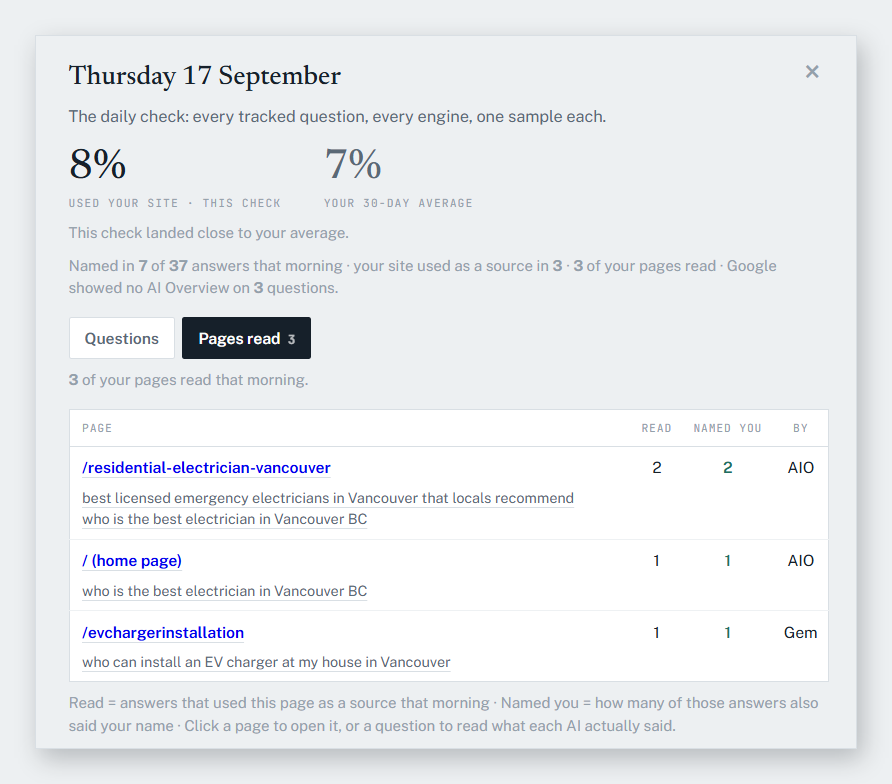
LLM Visibility Lens does that. It asks ChatGPT, Gemini, Google AI Mode and AI Overviews every morning, and Perplexity daily on the Pro and Agency plans. It keeps every answer and source, and shows each system's named rate with its range. Click any day to read what each one actually said.
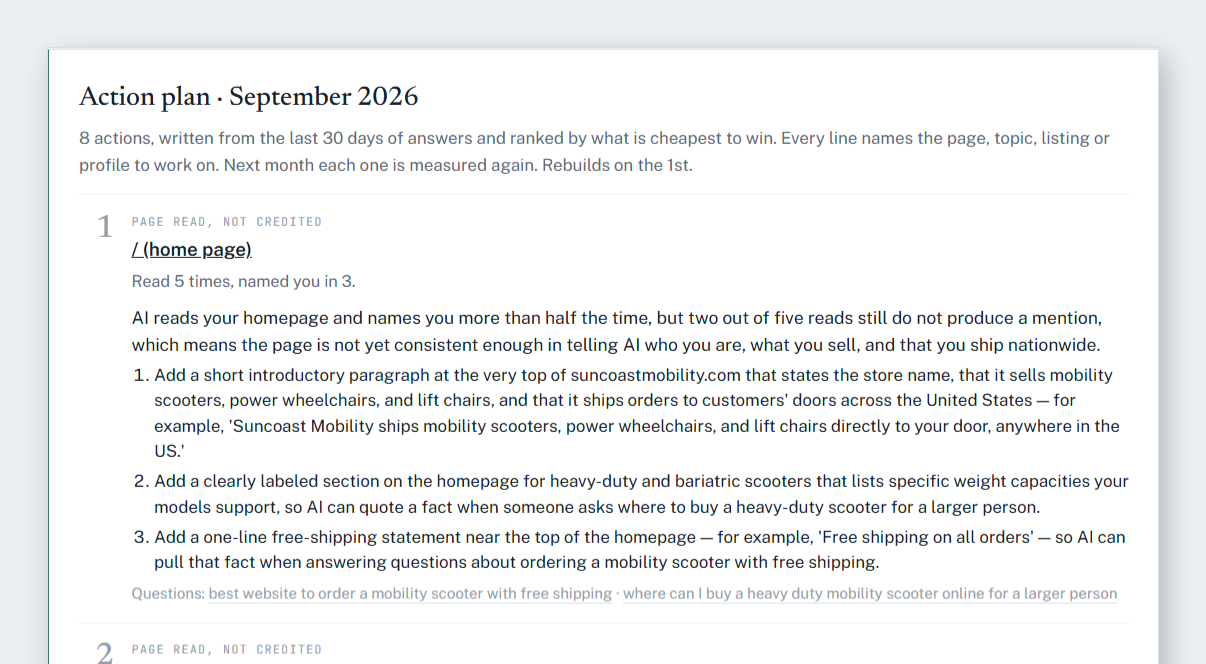
Each month it turns the data into an action plan: the directories to fix, the pages AI reads without naming you, and the rival pages it trusts.
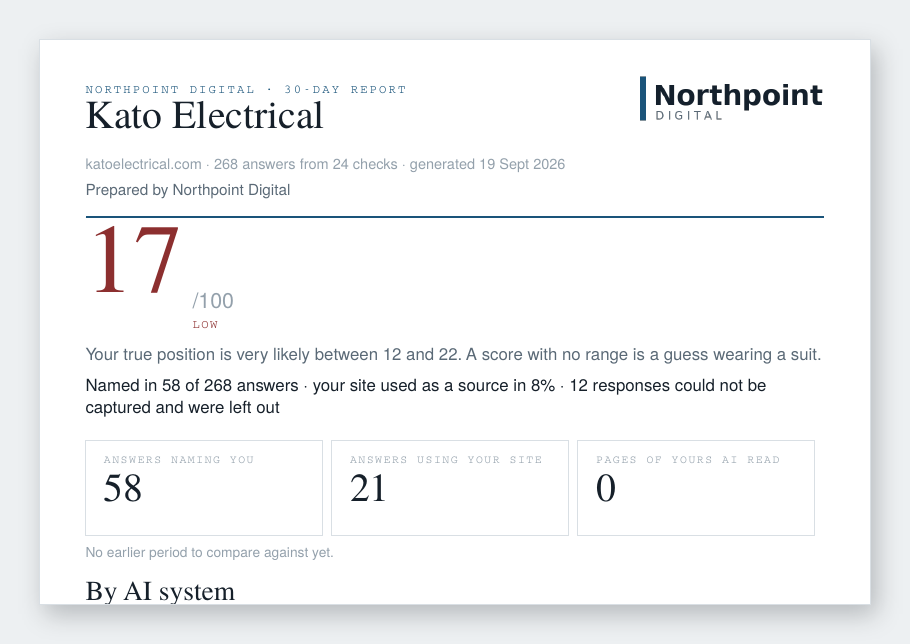
Agencies can send the monthly report under their own name, with each AI system reported separately. See the agency plan.
There's a plain comparison with Semrush's AI visibility tool, everything we ship is in the changelog, common questions are on the FAQ page, and data handling is on the security page. You can also find us on G2. If you'd like me to look at your own Perplexity and ChatGPT results, get in touch.
Questions people ask
Does Perplexity or ChatGPT recommend local businesses more often?
In our first week of side-by-side tracking, Perplexity did. On the same 16 questions over the same days, it named our test business, a Vancouver electrician, in 25% of answers against ChatGPT's 10%. It's one business and one week, so treat it as a strong early signal rather than a rule.
Why did Perplexity name the business more than ChatGPT?
Mainly because it read the business's website. Perplexity cited the site in 56% of its answers, ChatGPT in 2%, and every Perplexity answer that named the business also cited its site. Perplexity also used about five times as many sources per answer, which gives smaller businesses more chances to be included.
What sources does Perplexity use for local businesses?
In our data, 53% of Perplexity's links went to local businesses' own websites and 34% to directories and listing sites, led by BBB, Justdial, Yellow Pages and HomeStars. About 7% went to news and unrelated sites. Utility and city pages made up only 2%, compared with 21% for ChatGPT.
How do I get my business recommended by Perplexity?
Allow PerplexityBot in robots.txt and through your firewall, make each service page state clearly who you are, what you do and where, and keep your main directory profiles complete and consistent. In our data, Perplexity only named the business in answers where it had read the business's own website.
Is optimising for Perplexity different from optimising for ChatGPT?
Partly. Both need your site to be crawlable and your details consistent. Perplexity leaned on your own website and classic directories like BBB and Yellow Pages. ChatGPT rarely read the business's site and relied more on "best of" list sites and official pages, so getting onto the lists it reads matters more there.
Can I track how Perplexity and ChatGPT describe my business?
Yes. Ask both the questions your customers ask, logged out, daily for a few weeks, and note whether you're named and which sites they cite. Or use an AI visibility tracker that asks both on the same days and keeps every answer, so the comparison is like for like.

Harjeet Singh Bedi Founder, LLM Visibility Lens · SEO consultant, Bedi SEO
Harjeet is an SEO consultant who runs Bedi SEO and works hands-on with local businesses, online stores and agencies. He built LLM Visibility Lens after clients kept asking whether they showed up in ChatGPT and other AI tools and nobody could give them an honest, measured answer. Every figure in this article comes from answers his tool collected.