On this page
The short version
Voice search optimization, as a separate SEO job, is over. The assistants people talk to now hand the question to the same AI systems people type into. But the way people ask out loud still changes the answer, and that part nobody is measuring.
- The assistants became AI chatbots. Google Assistant on phones is being replaced by Gemini, Siri passes hard questions to ChatGPT, and Alexa+ runs on generative AI. (Why it died)
- Spoken questions did much worse. Across five AI systems, the same local business was named in 23% of answers to typed questions and 7% to spoken ones. (The data)
- Three systems never named it once. ChatGPT, Google AI Mode and AI Overviews: 0 of 105 answers to spoken questions.
- Perplexity was the exception. It named the business more often when the question was spoken: 33% against 20%.
- The fix isn't voice tactics. It's writing down how customers actually ask, and making your pages answer those conditions. (What to do)
What "voice search optimization" used to mean
The short answer: a set of tricks for getting a smart speaker to read your page aloud.
I've done SEO since 2010, so I remember the voice search wave well. The playbook went like this:
- win the featured snippet ("position zero"), because that's what the assistant read out;
- write FAQ pages with short, 30-word answers;
- target long, conversational "near me" keywords;
- add speakable markup.
It came with a famous prediction that half of all searches would be voice by 2020. Nobody ever properly measured that figure, and I won't repeat it as fact.
Some of it was sensible. Much of it was a separate project with its own budget and its own reports, and that's the part that's gone.
Why voice search optimization died
Because the assistants stopped being search boxes with a voice. They became AI chatbots.
Google Assistant is becoming Gemini. Google announced in March 2025 that it was upgrading Assistant users on mobile to Gemini. The move slipped into 2026, as 9to5Google reported. Then, according to Chrome Unboxed, Google told users the switch would become mandatory on phones from 4 September 2026. "Hey Google" on an Android phone now reaches Gemini.
Siri passes harder questions to ChatGPT. Since the iOS 18.2 update in December 2024, Siri can hand complex questions to ChatGPT, as NBC News covered at launch.
Alexa was rebuilt on generative AI. Amazon announced Alexa+ in February 2025, built on large language models, as eWeek reported.
So when someone talks to their phone, the answer increasingly comes from Gemini or ChatGPT. Those are the same systems they'd reach by typing. There isn't a separate voice index to optimise for.
Even the voice-specific markup is a dead end for most businesses. Google's speakable structured data is still in beta and limited to news publishers. And Google says plainly that its AI features need no special markup or optimisation beyond normal SEO.
What didn't die: the way people ask
People still talk differently from how they type. That's the part that survived, and it matters more now, not less.
Typed: "emergency electrician Coquitlam". Spoken: "Is there an electrician open right now in Port Coquitlam that can come out tonight?"
The spoken version is longer, more casual and full of conditions: right now, tonight, near me, who can quote a job this week. An old search engine mostly ignored those extra words. An AI system reads every one of them and tries to find a business that matches all of them.
So the question isn't "are you optimised for voice?" It's "when a customer asks the way people actually talk, does the AI still name you?"
That's why our tool's question finder now writes spoken versions of your customers' questions alongside the typed ones, free to try on your own site.
How we measured spoken vs typed
The short answer: we asked the same AI systems both kinds of question, on the same days, in text.
Our tool, LLM Visibility Lens, checks a business's questions every morning in ChatGPT, Gemini, Google AI Mode, Google AI Overviews and Perplexity, and stores every answer. Since 22 September 2026 it has also written spoken questions: two per topic, phrased the way a person says them out loud. They're full sentences starting with who, where, is there, can you or which, still naming a real place. For each topic, it tracks them next to the typed questions.
The business is Kato Electrical, a Vancouver-area electrician and our public demo. This comparison covers 23 to 28 September 2026: 10 typed questions and 6 spoken ones, across all five systems. The spoken questions averaged 20 words; the typed ones, 9.
What this data can't tell you. We type the spoken wording into each AI system. We don't record what Siri or Alexa says out loud, and nobody has a public count of how often anything is spoken. It's also one business, one week and six spoken questions, so read the numbers as a direction, not a verdict. The method is on the how it works page.
I sell this tracker, so weigh my enthusiasm accordingly. The demo is public if you want to check.
What the data shows
Spoken questions got the business named far less often, everywhere except Perplexity.
| AI system | Typed questions | Spoken questions |
|---|---|---|
| ChatGPT | 10 of 60 (17%) | 0 of 36 |
| Gemini | 12 of 60 (20%) | 2 of 36 (6%) |
| Google AI Mode | 19 of 60 (32%) | 0 of 36 |
| AI Overviews | 12 of 49 (24%) | 0 of 33 |
| Perplexity | 10 of 50 (20%) | 10 of 30 (33%) |
| All five | 63 of 279 (23%) | 12 of 171 (7%) |
ChatGPT, AI Mode and AI Overviews together gave 105 answers to spoken questions and named Kato in none. Take Perplexity out and spoken questions got him named in 2 of 141 answers (1.4%).
Before you read that as "spoken questions are hopeless", look at where they were about.
Kato's typed wins come mostly from Vancouver and Burnaby questions: "best electrician in Burnaby BC", "who is the best licensed electrician in Vancouver BC". The six spoken questions happened to be about Surrey, Squamish, Coquitlam, Port Coquitlam and North Vancouver, where he's weaker whichever way you ask. So part of the gap is place, not phrasing.
The fairest comparison is the one place both sets cover:
For Coquitlam, three typed questions got Kato named in 0 of 84 answers. Two spoken questions about Coquitlam and Port Coquitlam got him named in 4 of 56, all four by Perplexity. On like-for-like places, spoken did slightly better, and only in one system.
Two other details matter.
Google showed an AI Overview for spoken questions more often. It appeared on 33 of 36 spoken checks (92%), against 49 of 60 typed checks (82%). Long, conversational questions seem to trigger AI Overviews more reliably. That fits Google's statement that AI Overviews show up where they add something to classic results. We saw the other side of this in how to rank in AI Overviews, where short "best electrician in…" questions often got none.
The site was used about as often either way. Kato's website was cited in about 15% of answers to spoken questions and about 15% to typed ones. The AI systems found his pages just as often. They simply didn't name him as often when the question came with conditions attached.
What changes when a question is spoken
Look at the extra words. I think they're most of the story.
A spoken question adds conditions a typed one leaves out:
- Timing: "open right now", "tonight", "this week"
- The job: "commercial properties", "smart lighting in my whole house", "all the wiring for my home addition"
- Trust: "reliable", "do people trust", "licensed"
- The situation: "I smell something burning near my outlets"
An AI system answering that question looks for a business that clearly states it meets those conditions. "Electrician in Coquitlam" is easy to match. "Can come out tonight in Port Coquitlam" needs a page that says, in plain words, that you do after-hours calls in Port Coquitlam.
That's also my best guess at why Perplexity did better. It reads far more pages per answer, and it reads the business's own site more than ChatGPT does. We measured this in Perplexity vs ChatGPT. More pages read means more chances to find the one sentence that matches the condition. It's a hypothesis, not something this week's data proves.
What to do now
Drop "voice search optimization" as a project. Keep the insight behind it.
- Stop chasing voice-only tactics. No separate voice strategy, no speakable markup unless you're a news publisher, no 30-word answers written for a speaker. Google says AI features need nothing special.
- Write down how customers really ask. The best source is your own phone line and inbox. The words people use when they call you are the spoken questions. Or let the question finder draft them.
- Put the conditions on your pages. Opening hours and after-hours service, same-day or next-day availability, residential or commercial, the jobs you actually do, the towns you actually cover. Say them in plain sentences near the top of the relevant page, not just in a footer.
- Answer the situation, not only the service. "What to do if you smell burning near an outlet, and who to call in Surrey" is a real spoken question. A page that answers the first half safely and the second half with your name is exactly what AI systems look for.
- Cover each place properly. The spoken questions were weakest in the suburbs where Kato's typed questions were weakest too. Having a page for a town isn't enough. It has to answer the questions people ask about that town. The same lesson came up in ChatGPT citations.
- Measure spoken and typed separately. A blended number would hide that three AI systems named Kato in none of 105 spoken answers. See why single AI rankings mislead.
How to track spoken questions
Ask both versions of each question, typed and spoken, in the same AI systems on the same days, and compare the rates. Do it daily for a few weeks, because answers change from one day to the next.
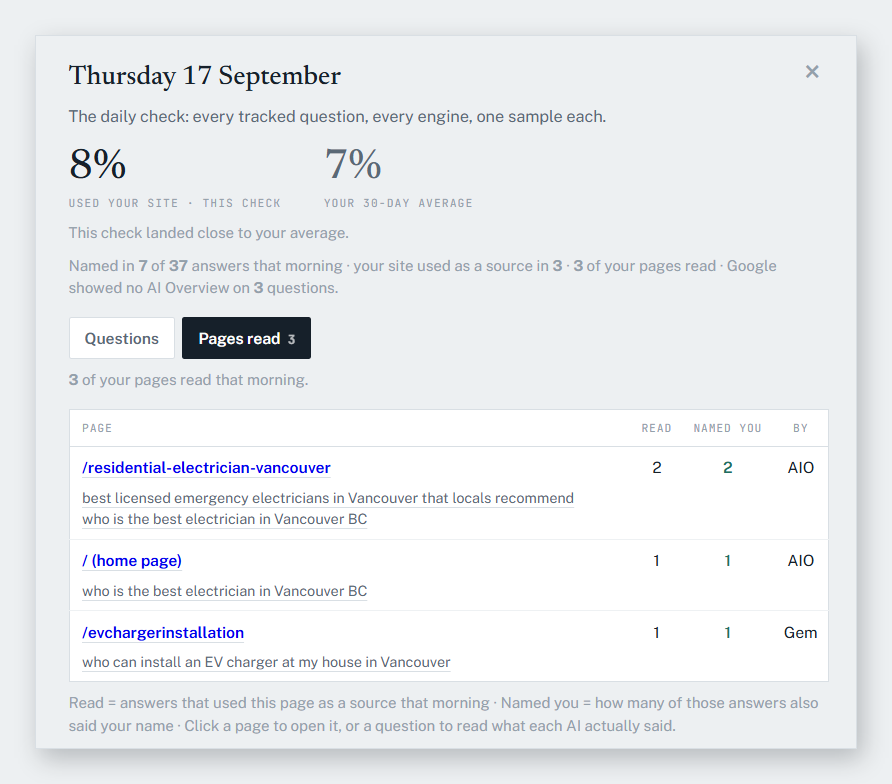
LLM Visibility Lens does this automatically. The question finder writes two spoken questions per topic, and the dashboard shows typed and spoken side by side for every AI system. Spoken questions are included on the paid plans, at no extra cost, within the same question limit.
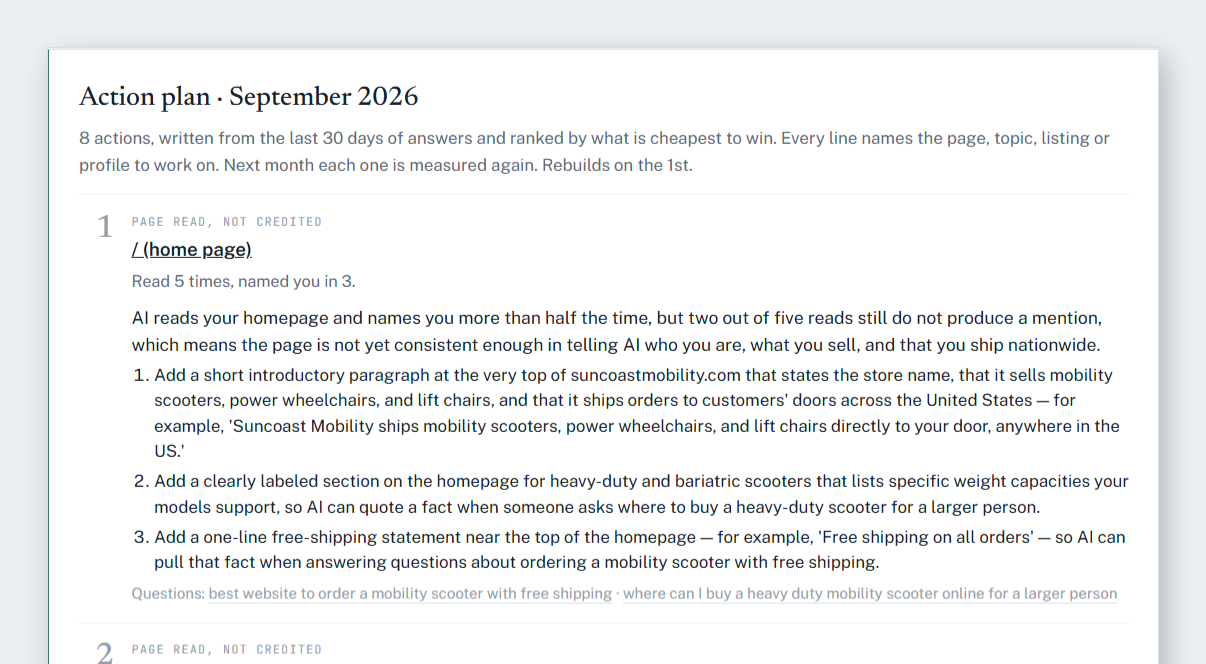
The monthly action plan includes the spoken questions too: which ones name nobody, which pages AI reads without naming you, and what to add.
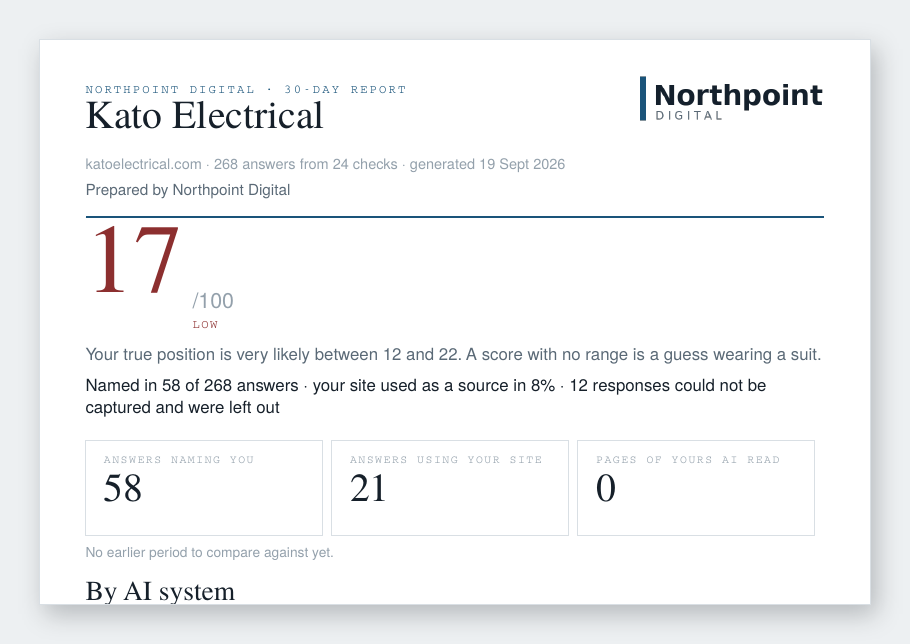
Agencies can send the report under their own name. See the agency plan.
There's a plain comparison with Semrush's AI visibility tool, everything we ship is in the changelog, common questions are on the FAQ page, and data handling is on the security page. If you'd like me to look at your own spoken questions, get in touch.
For the wider playbook, start with how to rank in ChatGPT and We asked AI who to hire 80 times.
Questions people ask
Is voice search optimization still worth doing?
Not as a separate project. Voice assistants increasingly hand questions to AI systems: Gemini on Android phones, ChatGPT through Siri for complex questions, and generative AI in Alexa+. What's worth doing is making sure your pages answer the longer, more conversational way people ask out loud, and tracking those spoken questions separately.
What is the difference between a typed and a spoken question?
A spoken question is longer and more casual, and it carries conditions a typed one leaves out. "Emergency electrician Coquitlam" becomes "Is there an electrician open right now in Port Coquitlam that can come out tonight?" In our data, spoken questions averaged 20 words against 9 for typed ones.
Do AI assistants recommend different businesses for spoken questions?
In our first week of data, they named our test business far less often. It was named in 23% of answers to typed questions and 7% to spoken ones across five AI systems. ChatGPT, Google AI Mode and AI Overviews named it in none of 105 spoken answers. Perplexity was the exception, naming it more often when the question was spoken.
Does Google still use speakable schema?
Speakable structured data is still listed by Google as a beta feature, and it's limited to news publishers. It isn't a general way for businesses to appear in voice or AI answers. Google says AI features in Search need no special markup beyond normal SEO best practice.
How do I find the spoken questions my customers ask?
Listen to how customers phrase things when they call or email you. Those are the spoken questions. Write them down as full sentences, including the conditions they mention, such as timing, location and the specific job. An AI visibility tool with a question finder can also draft spoken versions of your typed questions.
Can you measure voice search volume?
No. Nobody publishes a count of what people say to their phones or assistants, so any "voice search volume" figure is an estimate. What you can measure is what AI systems answer when a question is phrased the way people speak, and how often your business is named.

Harjeet Singh Bedi Founder, LLM Visibility Lens · SEO consultant, Bedi SEO
Harjeet has worked in SEO since 2010, first in agencies and now running Bedi SEO for local businesses, online stores and agencies. He built LLM Visibility Lens after clients kept asking whether they showed up in ChatGPT and other AI tools and nobody could give them an honest, measured answer. Every figure in this article comes from answers his tool collected.