On this page
The short version
A free AI visibility check is worth doing. Just don't read it as a score.
- One check is one snapshot. With the same 10 questions every day, Gemini named our test business on 0% of them some days and 50% on others. Its real rate was 21%. (The data)
- A single question is a weighted coin. Even a question the business usually wins came back "not named" about one time in five. (The numbers)
- One check is good for some things. Does AI know you exist? Who does it name instead? What does it read? (What it can do)
- The fix is repetition, not a better checker. About 40 answers gets you within roughly ±12 points. A month of daily checks gets you within ±2 or 3. (How many you need)
- You can do a proper check for free. Here's how. (Step by step)
People search "free AI visibility checker" because they want a quick answer to a fair question: does ChatGPT mention my business? A one-off check will give you an answer. This article shows, with a month of our own data, how much weight that answer can carry, and how to get a better one without paying anything.
I run a paid tracker, LLM Visibility Lens, which also has a free plan. So I have a stake here. Everything below comes from our public demo account, so you can check it.
How to run a free AI visibility check properly
The short answer: several buying questions, several AI systems, logged out, repeated over a few days.
- Pick five buying questions without your name in them. "Who's the best electrician in Burnaby?" not "Is Kato Electrical any good?" Brand questions flatter you. In one test, AI named a brand in 88% of answers when its name was in the question and 0% when a buyer asked where to buy. Our free question finder will write these questions from your website.
- Open a private or logged-out window. Logged-in ChatGPT can use your saved memories and past chats, as OpenAI explains in its memory FAQ. You want the answer a stranger gets.
- Ask each question in ChatGPT, Gemini, Google (look for an AI Overview or use AI Mode) and Perplexity. They disagree a lot, so one system tells you little about the others.
- Write down three things per answer: were you named, who was named instead, and which websites it cited. Also note when Google showed no AI Overview at all. That's not the same as "not named".
- Repeat on at least three different days. Then count. "Named in 7 of 60 answers" is a result. "ChatGPT mentioned us on Tuesday" is a story.
That's about 20 minutes a day. Tedious, but free, and far more honest than any single automated check.
What one check can tell you
A single check is good at yes-or-no questions about the basics. Specifically:
- Whether AI knows you exist. Ask about your business by name. If it can't describe what you do, fix that first: your website, your Business Profile, your main directory listings.
- Who it names instead. The competitors in the answer are useful even from one check. If the same two names keep appearing, study their pages.
- What it reads. The sources under the answer show which directories, list sites and competitors' pages AI trusts for your kind of question. Our ChatGPT citations study found those were mostly rivals' websites and "best of" lists, not Google or Yelp.
- Whether a question has no winner. If an answer names no business at all, there may be an open door. In our data, 38 of 43 answers to a cost question named nobody. Check it again before acting.
- Whether Google shows an AI Overview for that search. For some local searches, it mostly doesn't. See how to rank in AI Overviews.
Those are real, useful findings. None of them is a score.
What one check can't tell you
It can't tell you how visible you are. Two reasons.
AI answers change without anything changing. Language models pick their words with some randomness, and even with that turned down they don't give identical outputs, as Thinking Machines Lab explained. The sources they search change too. SparkToro's study of AI recommendations found the same list of brands came back less than 1% of the time, as Search Engine Journal summarised. We saw it ourselves: the same six questions, checked four times in one day, scored 13, 25, 18 and 20.
It even happens inside a single check. On 27 August we ran one quick check on "who offers emergency electrician service in Vancouver at night". Our tool asks each AI system twice in a quick check. Google's AI Mode named Kato in one of those two answers and left him out of the other: same question, same check. Over the following month, AI Mode named him on that question in 10 of 31 daily answers (32%). Either of those two answers, taken alone, would have told you something false.
A single question gives a yes or a no, never a rate. Each question has an underlying chance of naming you. One check flips that coin once.
On "who is the best electrician in Vancouver BC", Google's AI Mode named Kato in 28 of 35 daily answers. A single check would have said "not named" about one time in five. In Gemini, the same question named him in 18 of 35: a true coin toss. On EV charger installation, ChatGPT named him in 12 of 34, so a single "yes" there would have been a lucky flip. A free checker that shows one answer can't tell these situations apart.
We looked at every question in every AI system that had at least 20 daily answers: 38 pairs in all. Not one named Kato every single day. Even the best, ChatGPT on "best electrician in Burnaby BC" at 33 of 34, missed once. Eighteen pairs never named him, and there a single "not named" is simply correct. The other 20 were mixed, and 12 of those sat between 20% and 80%, where one check is close to a coin toss.
The catch is that a single check can't tell you which kind of pair you're looking at. A "no" from a never-named question and a "no" from a 50/50 question look exactly the same.
It also can't tell you:
- whether you're improving. Compare one check before a change with one check after and you're comparing two coin flips. Why there's no rank #1 in ChatGPT covers this.
- how the AI systems compare. One answer from each proves nothing about which one favours you.
- what your customers see. They ask from their own location, logged in, with their own history.
What a single check would have told you
Here's the clearest way to see it: a month of daily checks on the same 10 questions, one dot per day.
We track Kato Electrical, a Vancouver-area electrician and our public demo. From 30 August to 22 September 2026 the same 10 questions were asked every day. Each dot below is one day's result: how many of the 10 answers named him. That's exactly what a one-off "check my business" run would have returned on that day.
| AI system | Long-run rate (same 10 questions) | Best single day | Worst single day | Days within 5 points of the long-run rate |
|---|---|---|---|---|
| ChatGPT | 15% (35 of 230) | 30% | 0% | 11 of 23 |
| Gemini | 21% (50 of 240) | 50% | 0% | 7 of 24 |
| Google AI Mode | 33% (78 of 240) | 50% | 10% | 7 of 24 |
Read the Gemini row again. Check on 5 September and you'd think AI names Kato in half its answers. Check on 12 or 13 September and you'd think it never does. Nothing on his website changed in between.
Across the three systems, a one-day check landed within five points of the real rate only about a third of the time. And that's a check of 10 questions. Most free checkers run fewer.
A quick note on method: the counts come straight from the tool's database. Days with a failed run are left out, and later weeks with more questions are excluded so the comparison stays like for like. The full method is on the how it works page.
How many checks you actually need
More answers, narrower range. Here's the rough margin of error for a business named about 20% of the time:
| What you check | Answers | Rough range |
|---|---|---|
| 1 question, 1 AI system, once | 1 | yes or no |
| 1 question, 4 AI systems, once | 4 | ±39 points |
| 10 questions, 1 AI system, once | 10 | ±25 points |
| 10 questions, 4 AI systems, once | 40 | ±12 points |
| 5 questions, 4 AI systems, weekly for a month | 80 | ±9 points |
| 10 questions, 4 AI systems, daily for a month | 1,200 | ±2 points |
These use the standard 95% formula our tool shows next to every score. Real answers from one day are a bit linked to each other, so treat these ranges as the best case. Even then, the lesson is clear: one check can't separate 10% from 40%. A month of daily checks can separate 18% from 22%.
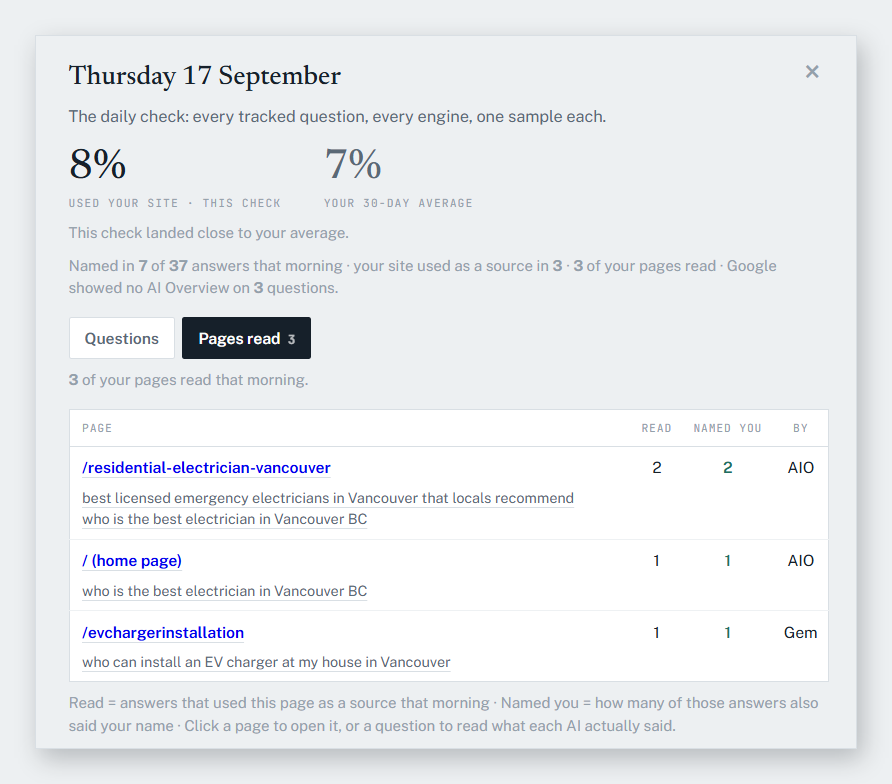
Curious what a month looks like? Open the live demo and click any day's dot to read that day's answers.
Free options compared
There's more than one free way to do this, and they're good for different things.
| Option | Cost | What it gives you | Good for |
|---|---|---|---|
| Checking by hand | Free, ~20 min a day | Real answers, your own notes | A first look, if you're disciplined |
| Question finder | Free | The buying questions to ask, written from your website | Knowing what to check |
| Free plan | Free | 5 questions, checked weekly, plus a few quick checks | A slow, honest trend |
| Paid plans | See pricing | Daily checks, more questions, Perplexity on Pro and Agency, monthly action plan | A rate you can act on |
In our tool, one-off quick checks ("Ask AI now") are shown so you can see the answers, but they never move your score. For the reasons above, they shouldn't.
How to read a free checker's result
If you use any free AI visibility checker, ours or anyone else's, ask five questions of the result:
- How many answers is it based on? Under about 40, treat it as a hint.
- Were the questions about your brand, or about buying? Only buying questions tell you about recommendations.
- Which AI systems? A single blended number can hide a zero in one of them.
- Does it separate "not named" from "no AI answer"? Google often shows no AI Overview for local searches.
- Can you read the actual answers and sources? The names and sources are the most useful part of a single check.
A checker that answers all five honestly is worth using. One that shows a big confident score from a handful of answers is selling a feeling.
What to do next
Start free, then decide.
- Run the question finder to get the right questions.
- Check them by hand for a week, or put five on the Free plan.
- If the numbers matter to your business, track daily. How to rank in ChatGPT covers what to do with the results.
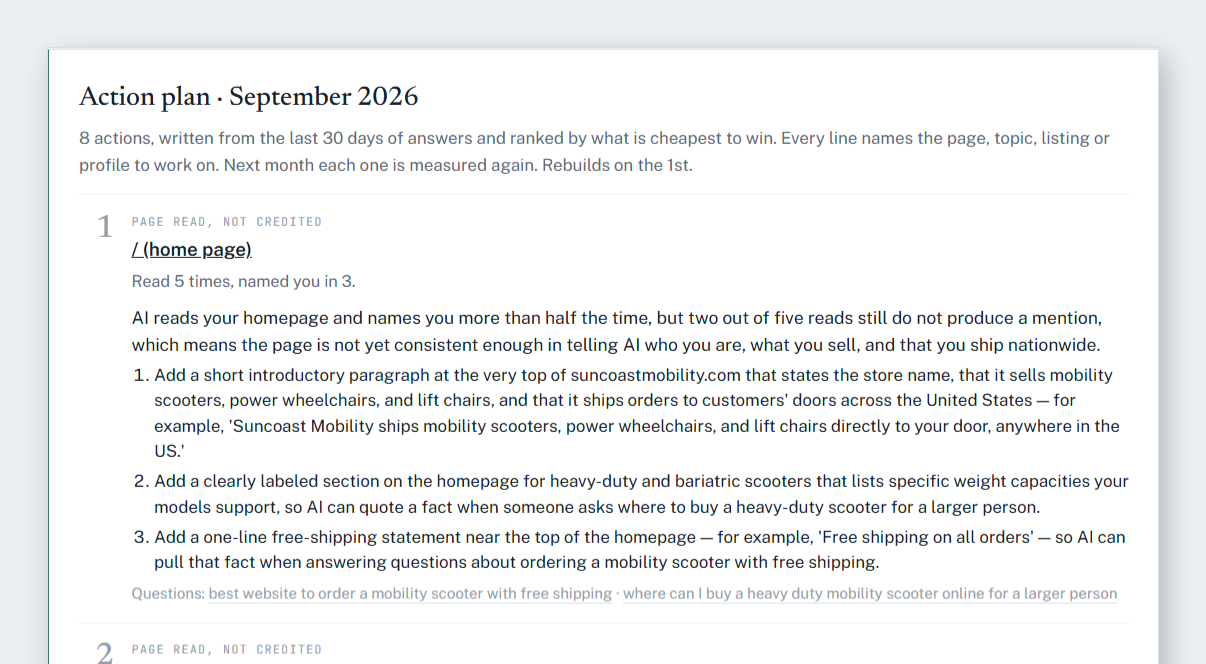
Paid plans add a monthly action plan built from the data: the unclaimed questions, the pages AI reads without naming you, and the sites to get listed on.
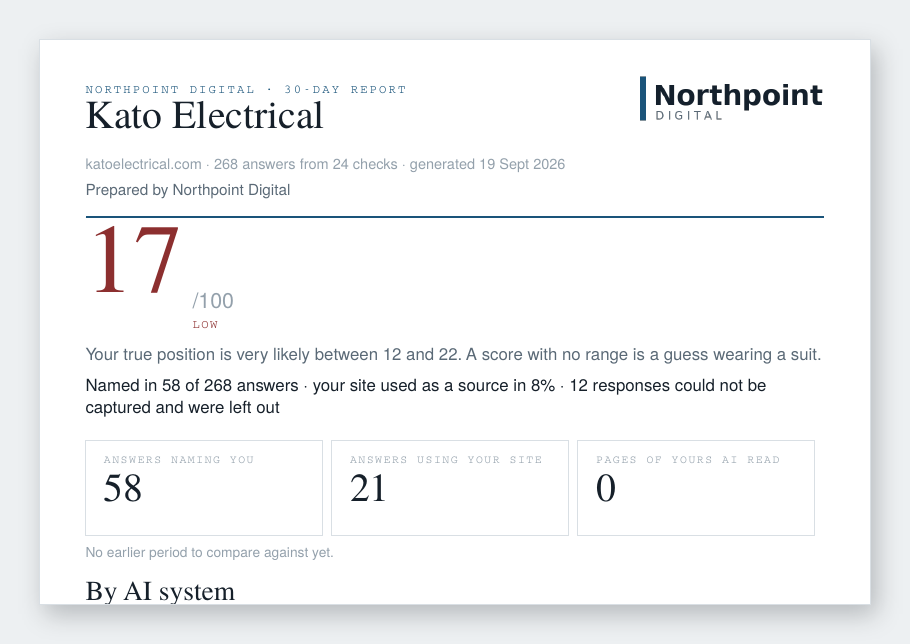
Agencies can send the monthly report under their own name, with every score shown alongside its range and answer count. See the agency plan.
For more on the underlying patterns, see We asked AI who to hire 80 times, Perplexity vs ChatGPT and why spoken questions get different answers. There's also a plain comparison with Semrush's AI visibility tool, the changelog, the FAQ page and the security page. If you'd like me to look at a result someone sent you, get in touch.
Questions people ask
Is there a free AI visibility checker?
Yes. You can check by hand for free by asking ChatGPT, Gemini, Google and Perplexity your customers' buying questions in a logged-out window, and some tools, including ours, have a free plan. Whichever you use, base your view on dozens of answers over several days, not one check.
How do I check if ChatGPT mentions my business?
Ask ChatGPT the questions a customer would ask, such as "who's the best electrician in Burnaby", not your business name, in a private or logged-out window. Note whether you're named and which sites it cites. Repeat over at least three days, because the answer changes from one day to the next.
Why does a free AI visibility check give different results each time?
AI systems generate each answer fresh, with some randomness, and may search different sources each time. In our data, the same 10 questions got a business named on 0% of them one day and 50% another, in the same AI system, with nothing changed on the website.
How many checks do I need for a reliable AI visibility score?
About 40 answers gets you within roughly ±12 points, 80 within about ±9, and a month of daily checks across several AI systems within 2 or 3 points. One question checked once is only a yes or a no.
What can a single AI visibility check tell me?
It can show whether AI knows your business exists, which competitors it names instead, which websites it reads, whether a question names no business at all, and whether Google shows an AI Overview for that search. It can't tell you how often you're recommended or whether that's improving.
Does being logged in to ChatGPT change the results?
It can. Logged-in ChatGPT may use saved memories and past chats to personalise answers. For a check that reflects what a new customer sees, use a private or logged-out window, and ask from the location your customers are in.

Harjeet Singh Bedi Founder, LLM Visibility Lens · SEO consultant, Bedi SEO
Harjeet has worked in SEO since 2010, first in agencies and now running Bedi SEO for local businesses, online stores and agencies. He built LLM Visibility Lens after clients kept asking whether they showed up in ChatGPT and other AI tools and nobody could give them an honest, measured answer. Every figure in this article comes from answers his tool collected.