On this page
The short version
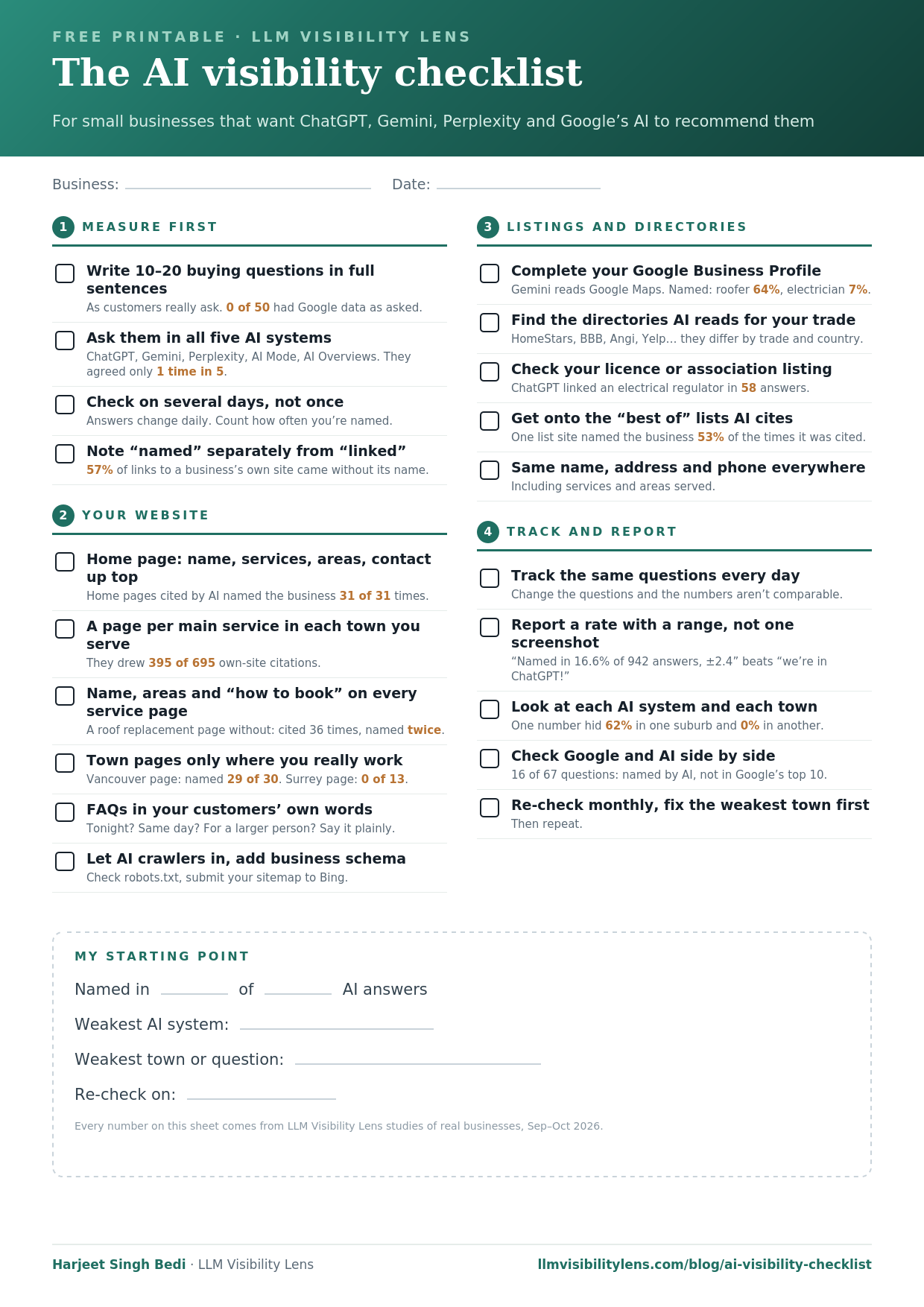
This is the AI visibility checklist I use with my own small business clients: 20 items in four groups, each backed by a real number from our tracker. Print it, work through it, and you'll know where you stand with ChatGPT, Gemini, Perplexity and Google's AI.
- Measure first: 4 items
- Your website: 6 items
- Listings and directories: 5 items
- Track and report: 5 items
Open the free printable checklist. It's one A4 page with tick boxes and space for your starting numbers.
Why this checklist is different
The short answer: every item is there because the data put it there.
Most AI search checklists are opinions. This one comes from our tracker, LLM Visibility Lens, which asks real businesses' buying questions every day in five AI systems and records who gets named and which pages get read. The numbers below come from a Vancouver electrician (Kato Electrical, our public demo) and several other businesses we track anonymously, in September and October 2026.
I sell that tracker, so weigh my view. But every item on this list works without it.
Group 1: Measure first
The short answer: you can't fix what you haven't measured, and AI answers change too much for one check.
1. Write 10 to 20 buying questions in full sentences. Write them the way customers actually ask: "my power is out in Coquitlam tonight, who can come quickly", not "emergency electrician Coquitlam". Of 50 real buying questions we checked, 0 had Google search data in those words, yet AI named a business in 52% of answers to them. See questions nobody searches on Google. The free question finder can draft them from your website.
2. Ask them in all five AI systems. That's ChatGPT, Gemini, Perplexity, Google AI Mode and Google AI Overviews. On the same morning they agreed on a business only about 1 time in 5 (5 AIs, same questions), and the best one differed for every business (which AI recommends local businesses most).
3. Check on several days, not once. Answers change from run to run. Count how often you're named across days; see what one free check can and can't do.
4. Note "named" separately from "linked". When AI links to your website, it isn't necessarily recommending you: 57% of links to a business's own site came without its name (when your own web page helps a competitor).
Group 2: Your website
The short answer: make every page say who you are, what you do, where, and how to book.
5. Home page: name, services, areas and contact in the first screen. AI rarely cites home pages for buying questions, but when it did, it named the business 31 times out of 31 (which pages AI reads).
6. A page for each main service in each town you serve. Pages that name both a service and a place drew 395 of 695 own-site citations for an electrician and a roofer.
7. Your name, areas and "how to book" on every service page. A roof replacement page with no town and no booking line was cited 36 times and named the roofer twice. AI used it for facts and recommended others.
8. Town pages only where you really work. Kato's Vancouver page named him in 29 of 30 answers that cited it. His Surrey page: 0 of 13, because little else online connects him to Surrey.
9. FAQs in your customers' own words. Do you come out tonight? Same day? Do you deliver to a larger person's home? Say it plainly, because those situations are exactly what people ask AI.
10. Let AI crawlers in, and describe your business in code. Check your robots.txt against OpenAI's crawler documentation, submit your sitemap in Bing Webmaster Tools, and add local business structured data.
Group 3: Listings and directories
The short answer: AI reads directories and lists before it recommends anyone, and each AI system reads different ones.
11. Complete your Google Business Profile. Gemini reads Google Maps more than anything else. When it did, it named a roofer in 64% of answers and the electrician in 7%. Same source, different profile strength. Start at Google Business Profile, and see Google Business Profile and AI answers.
12. Find the directories AI reads for your trade. For a Canadian electrician, HomeStars and BestProsInTown. For an American roofer, Angi, BBB, Yelp and HomeAdvisor. They differ by trade and country, so check yours; see the directories AI reads.
13. Check your licence or association listing. ChatGPT linked BC's electrical safety regulator in 58 answers. Make sure your registration matches your business name exactly.
14. Get onto the "best of" lists AI cites. One list site named the electrician in 53% of the answers that cited it. Find which lists appear in your answers, and ask how to be considered. More in which websites ChatGPT trusts.
15. Use the same name, address and phone everywhere. Include your services and areas served. Google's guide to business details in Search is a good checklist for this item.
Group 4: Track and report
The short answer: track the same questions over time, and read the parts, not one score.
16. Track the same questions every day. If you change the questions, the numbers stop being comparable.
17. Report a rate with a range, not a screenshot. "Named in 16.6% of 942 answers, give or take 2.4" tells you something. "We're in ChatGPT!" doesn't. See how to report AI visibility to clients.
18. Look at each AI system and each town separately. One overall figure, 16.6%, hid 62% in one suburb and 0% in two others (why a single AI visibility score can mislead you).
19. Check Google and AI side by side. On 16 of 67 questions we tracked, AI named the business even though its site wasn't in Google's top 10, and the reverse happened too (Invisible on Google, recommended by AI).
20. Re-check monthly and fix the weakest town or question first. Then repeat. Small, steady fixes beat one big rewrite.
What not to bother with
- Buying "AI search volume" data. Nobody publishes how often people ask AI a question, so any such number is a guess.
- Chasing "rank #1 in ChatGPT". There's no fixed rank; see why there's no rank #1 in ChatGPT.
- Stuffing pages with keywords. AI picks pages that answer a situation clearly, not pages that repeat a phrase.
- Rewriting everything at once. Change a few pages, then measure.
How long it takes
For a small business with one location, a rough guide:
- Group 1, measuring: about an hour to write the questions, then a few minutes a day for a week, or let a tracker do it.
- Group 2, your website: a day or two, depending on how many service and town pages you need.
- Group 3, listings: a few hours, spread over a week while listings get approved.
- Group 4, tracking: ongoing, about 30 minutes a month to review.
If you'd rather not check by hand, LLM Visibility Lens asks your questions in all five AI systems every day. It shows who gets named, which of your pages and which directories AI read, and an action plan for the gaps. See it running on Kato's account in the live demo, check the plans (they start free), or see the agency plan if you look after several businesses.
More reading:
- How to get recommended by ChatGPT
- How to rank in ChatGPT
- How to rank in AI Overviews
- Google AI Mode for local businesses
- AI Overview tracking for near me searches
- Perplexity vs ChatGPT
- ChatGPT citations for local businesses
- Spoken questions
- 5 AI systems, 35 questions
- We asked AI who to hire 80 times
The method is on the how it works page. There's also a comparison with Semrush's AI visibility tool, the changelog, the FAQ page and the security page. Google explains how its AI features use your site in AI features and your website. If you'd like me to go through the checklist with you, get in touch.
Questions people ask
What is an AI visibility checklist?
It's a list of steps that help AI systems like ChatGPT, Gemini, Perplexity and Google's AI find, understand and recommend your business. This one has 20 items in four groups: measure first, your website, listings and directories, and track and report.
How do I check if ChatGPT recommends my business?
Write the questions your customers ask in full sentences, ask them in ChatGPT on several different days, and count how often your business is named. Do the same in Gemini, Perplexity, Google AI Mode and AI Overviews, because each one gives different answers.
Which item on the checklist matters most?
For most local businesses, pages for each main service in each town you serve, plus a complete Google Business Profile. In our data, pages naming a service and a place drew most of the citations, and Gemini relied on Google Maps more than any other source.
Do I need to pay for a tool to use this checklist?
No. Every item can be done by hand. A tracker saves time on the measuring and tracking groups, because it asks your questions in all five AI systems every day and keeps the counts for you.
How often should I go through the checklist?
Work through all of it once, then re-check monthly. Answers change from day to day, so track the same questions over weeks before deciding whether a change worked.
Is AI visibility different from SEO?
They overlap. Good SEO helps, especially for Google's own AI features. But in our data, Google rankings and AI recommendations disagreed on about a third of questions, and AI leaned heavily on directories, lists and clear service pages.

Harjeet Singh Bedi Founder, LLM Visibility Lens · SEO consultant, Bedi SEO
Harjeet has worked in SEO since 2010, first in agencies and now running Bedi SEO for local businesses, online stores and agencies. He built LLM Visibility Lens after clients kept asking whether they showed up in ChatGPT and other AI tools and nobody could give them an honest, measured answer. Every figure in this article comes from answers his tool collected.